6 Week Tour Promotion to Sell Out Local Shows for Independent Artists
If you have a confirmed date, your next move is simple: announce it with a working ticket link, push it to every owned channel you have, and start a promotion cadence built around three pillars: your owned audience, creator seeding, and local outreach. That’s it. Everything else in tour promotion for independent artists is a variation on those three moves, and UpNComer exists mostly to help you run them without losing your mind.
TL;DR:
- Pre-tour technical groundwork, such as testing the ticket URL and updating bios, is crucial to avoid losing sales before promotion begins.
- Starting formal promotion about six weeks prior to the show ensures enough lead time for fans to plan, especially with weekly targeted deliverables.
- Seeding 20 to 40 micro creators consistently over time boosts durable discovery and helps fill local shows with interested audiences.
- Local flyers, partnerships, and media outreach should begin 2 to 3 weeks before the event, focusing on high-traffic neighborhoods and relevant community channels.
- Paid advertising is most effective after establishing organic momentum, with a small initial budget of $20 to $50 to test interest before scaling.
Table of Contents
- What Belongs on Your Pre-Tour Checklist?
- What Should Your 6-Week Tour Promotion Timeline Look Like?
- How Do You Build an Audience That Actually Buys Tickets?
- How Do You Turn Local Awareness Into Ticket Sales?
- What’s the Right Ad Budget and Targeting for Tour Dates?
- What Should Happen the Night of the Show?
- How Do You Follow Up With Fans After the Tour Ends?
- How Should You Price Tickets and Choose a Platform?
- How Can Partnerships and Sponsorships Support a Tour?
- How Do You Plan Tour Routing and Venue Logistics?
- Author Perspective: Tradeoffs, Mistakes, and When to Get Help
- How UpNComer Coordinates Tour Promotion End to End
- Sources
- FAQ
What Belongs on Your Pre-Tour Checklist?
Most ticket sales die before promotion even starts, usually because the technical groundwork was never done. You can have the best poster campaign in the city and still lose sales if your ticket link is broken or your bio hasn’t been updated since last spring.
Before you write a single caption, get these items locked down:
- Put your ticket URL and a smart link in your bio, then test the purchase flow yourself, on mobile, start to finish.
- Segment your email list by city or region so local subscribers get a targeted, event-specific send instead of a generic blast.
- Build a short EPK or one-sheet and a vertical promo clip sized for Instagram and TikTok, not a leftover landscape video from your last music video shoot.
- Add the show to Bandsintown and Songkick so it syndicates to your streaming profiles, then update your website and Eventbrite or venue listing to match.
Your website works as the hub that ties all of this together. If a fan lands there from a streaming profile and can’t find the show in ten seconds, that’s a lost ticket.
What Should Your 6-Week Tour Promotion Timeline Look Like?
Formal promotion for a local show should start about six weeks out. Tools 4 Musics research on local show attendance found that promotion starting later than that consistently misses potential attendees who needed more lead time to plan a night out and buy a ticket.
Here’s how to break the six weeks down into deliverables:
- Weeks 6 to 4: Post the full show announcement, launch your early-bird ticket tier, brief local press and the venue on your plans, and start seeding creators with clips and stems.
- Weeks 4 to 2: Publish mid-campaign content (behind-the-scenes clips, countdown posts), run a small local ad test, and finalize your poster and street-team deployment plan.
- Weeks 2 to 1: Ramp up street teams and local listings, send email reminders with urgency messaging, and activate any co-artist cross-promotion.
- Final 3 days to show day: Push ads harder with scarcity messaging (“last 20 tickets”), coordinate your venue-entry activation, and assign day-of roles so nobody’s scrambling at soundcheck.
Each week should end with one deliverable published, not a vague intention to “post more.” Momentum is the whole point.
How Do You Build an Audience That Actually Buys Tickets?
Streaming numbers and follower counts feel good, but they don’t fill a room by themselves. The artists who convert digital reach into local ticket sales treat discovery and ownership as two separate jobs.
Start with creator seeding. Slow Oak Studio’s 2026 playbook recommends seeding 20 to 40 nano and micro creators in the content categories your sound naturally fits, whether that’s dance clips, mood edits, or gear talk. Give them stems, a short clip, and a simple, clear brief instead of a rigid script.
- Treat creators as ongoing collaborators, not one-off transactions. The same source found that creators who keep using a sound over weeks drive more durable discovery than a single seeded post.
- Keep your release cadence steady, roughly one single every 4 to 8 weeks, so DSPs have fresh signals to work with heading into your tour dates, a pattern Berklee’s marketing research also points to.
- Offer an exclusive pre-sale window or a merch bundle to your email list and Discord members before the general public sees the ticket link.
- Watch saves, full listens, and playlist adds more closely than raw plays. Those are the signals that push DSPs to recommend you further.
Pro Tip: Don’t just seed a creator and disappear. Comment on their post, repost it to your story, and thank them by name. That small effort is often the difference between a one-time favor and a creator who champions your sound for months.
If you want a deeper breakdown of DSP pitching windows, UpNComer’s guide to playlist pitching best practices walks through timing your submissions around release dates.
How Do You Turn Local Awareness Into Ticket Sales?
Digital reach means nothing if the people three blocks from the venue don’t know the show exists. Local promotion is still where a lot of tickets get sold, especially for smaller rooms.
Poster and flyer placement works best when it starts 2 to 3 weeks before the show and stays concentrated in music-adjacent neighborhoods, according to American Guerrilla Marketing’s data from running street-level campaigns across 30 cities. Spreading flyers too thin across a whole city wastes print budget on people who were never going to come anyway.
- Coordinate a short venue-entry activation on show night, something as simple as a table with stickers or a QR code, near the corridor where the line forms.
- Submit the show to local event calendars, alt-weeklies, and campus newspapers, then brief a local radio show or community podcast if one exists in your genre lane.
- Choose co-artists for the bill who bring overlapping local fans, not just friends who happen to play music.
- Confirm every promo commitment in writing, including who posts what and when, so nothing falls through between you, the venue, and the opener.
If hiring outside help sounds appealing at this stage, ExperienceByLocals’ guide to what local promoters actually do is worth a read before you sign anything.
What’s the Right Ad Budget and Targeting for Tour Dates?
Paid ads for tour dates work best as an amplifier for something already showing life, not a way to manufacture interest from nothing.
Run geo-targeted campaigns on Meta and TikTok using short live clips or venue walk-throughs as creative. Concert footage almost always outperforms a static flyer graphic, because it shows people what the night will actually feel like.
- Start with a $20 to $50 local test budget before committing more.
- Scale spend only if your cost per ticket meets the target you set going in, not just because impressions look strong.
- Target by city, music interests, and lookalike audiences built from your saves and listener data.
- Track the full funnel: click, then ticket-page conversion, then cost per ticket, then incremental sales beyond what you’d have sold organically.
Liminl’s 2026 guide to indie marketing found that real movement on tickets is possible with a budget as small as $20 to $50 for a local test, with larger monthly budgets in the $300 range reserved for artists who’ve already validated demand. Don’t skip straight to $300 if you haven’t proven the $20 test works first.
If you want help running and measuring these tests without spreadsheets multiplying by the week, UpNComer’s campaign management guide covers the same measurement discipline.
What Should Happen the Night of the Show?
The show itself is a promotion opportunity, not just a performance. What happens at the door and on stage sets up everything that follows.
Set a run sheet and place merch somewhere fans pass on the way in, not tucked in a back corner they’ll never wander toward. A short pre-show activation, an acoustic song or a quick Q&A, gives people a reason to arrive early and gives you fresh content for the next release cycle.
- Collect emails or phone numbers at the door with a tablet or a QR code on the merch table.
- Trigger an automatic post-show thank-you message with a small merch discount within 24 to 48 hours.
- Use ticket-count updates and small scarcity offers (“last chance, doors close at 9”) in your final 72-hour and 24-hour pushes.
- Assign someone specific to run the door capture. It never happens reliably if it’s “everyone’s job.”
Pro Tip: Ask fans at the merch table one quick question, like which city they’d want you to play next. It takes ten seconds and hands you real routing data for your next tour instead of a guess.
How Do You Follow Up With Fans After the Tour Ends?
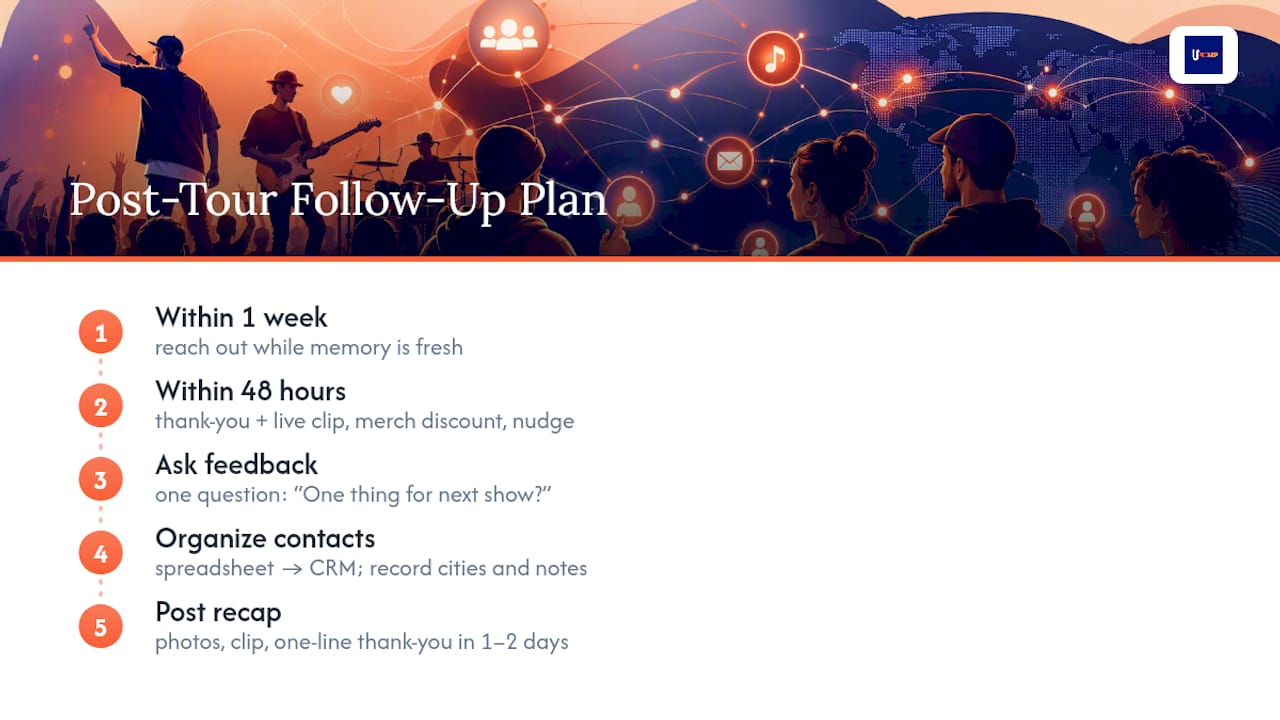
The show ending is not the end of the relationship. It’s the start of a longer one, if you follow up within the first week while the memory is still fresh.
Send a thank-you email or SMS to everyone who bought a ticket or scanned in, ideally within 48 hours. Include a link to a live clip from the actual show, a merch discount, and a soft nudge toward your next release or upcoming date. People who just spent money and an evening on you are your warmest audience of the year, so don’t let that window close quietly.
Ask for feedback, but keep it short. A single question, “What’s one thing you’d want at the next show?”, gets far more responses than a five-question survey nobody finishes. Use what you learn to adjust your next run: maybe the merch table needs better lighting, or the opener ran too long.
Route your new local contacts, whether they’re venue bookers, fans, or fellow artists, into a system you’ll actually check before your next tour. A spreadsheet works until it doesn’t; a proper CRM or artist manager tool keeps names, cities, and notes from scattering across three different phones. This is also the moment to plan your next single or release around the cities that performed best, since a steady release cadence keeps that new local audience engaged instead of letting it go cold.
Finally, post a short recap, photos, a clip, a one-line thank-you, within a day or two while fans are still tagging you. That recap becomes the seed content for your next tour announcement.
How Should You Price Tickets and Choose a Platform?
Ticket pricing shapes attendance more than most artists give it credit for. Price too high for an unproven room and you’ll sell to nobody; price too low and you leave money on the table you’ll need for gas and merch restock.
Early-bird pricing rewards the fans who commit first and gives you real signal on demand weeks before the show. A $10 early-bird tier that jumps to $15 at the two-week mark does two things: it creates urgency, and it gives you a rough headcount early enough to adjust your promotion push if sales are slow.
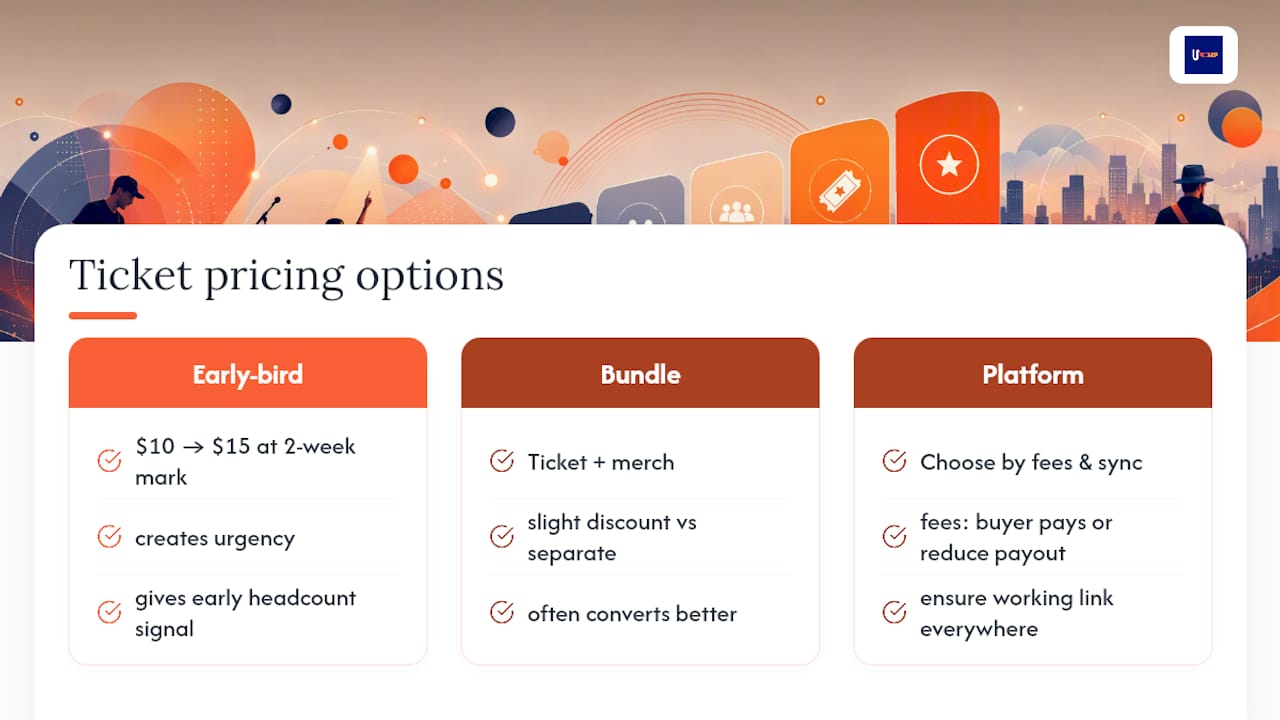
Bundles are worth testing, especially for opening or headlining a small room. A ticket-plus-merch bundle at a slight discount to buying both separately often converts better than a bare ticket, because it feels like more value for the same commitment.
Choose your ticketing platform based on fees and how easily it syncs with Bandsintown, Songkick, or your venue’s own system. Some platforms pass service fees to the buyer, others eat into your payout, so read the fine print before you commit to one for a whole run of dates. Whatever platform you pick, make sure the link works everywhere: bio, website, event listings, and every social post that mentions the date. A broken or outdated ticket link is one of the most avoidable ways to lose a sale you’d already won.
How Can Partnerships and Sponsorships Support a Tour?
Local businesses and small brands are often more open to partnership than artists assume, especially when the ask is specific and low-cost for them.
A coffee shop near the venue might let you post a flyer in exchange for a shoutout, or a local clothing brand might trade a merch table spot for a mention in your show recap. These aren’t major-label sponsorship deals, they’re small, mutual favors that add local credibility and free reach.
Look for businesses that already serve your fan base: record stores, tattoo shops, breweries, skate shops, whatever fits your scene. Approach them with a clear, short pitch: what you’re asking for, what they get, and a deadline. Vague requests get ignored; specific ones get answered.
Media partnerships work the same way. A local blog, radio show, or podcast covering the local scene often needs content as much as you need exposure. Offering an exclusive premiere of a tour-clip or an interview slot gives them something to publish and gives you a credible third-party mention.
Keep every agreement, even a casual one, confirmed in a text or email so both sides remember what was promised. Partnerships that stay informal tend to fall apart right when you need them most, the week of the show.
How Do You Plan Tour Routing and Venue Logistics?
Routing decisions made months out determine whether your tour makes money or drains it. The instinct to book every city that will have you usually backfires.
Cluster dates geographically so you’re not driving eight hours between shows when a five-city radius could work instead. Fuel, lodging, and fatigue add up fast, and a poorly routed tour eats profit before a single ticket sells. Look at where your streaming and social data actually show concentration, not just where you have a friend with a couch.
Venue selection matters as much as routing. A 200-capacity room that sells out feels and photographs better than a 500-capacity room at 40% full, and it protects your guarantee if the promoter is paying based on a percentage of the door. Match venue size to your realistic draw in that specific city, not your draw in your hometown.
Factor in travel time between load-in and set time, especially for DIY tours without a driver on payroll. Build in buffer days after long drives so a delayed show doesn’t wreck the next date. Confirm load-in times, backline availability, and merch table space with each venue at least two weeks out, not the day you arrive.
Author Perspective: Tradeoffs, Mistakes, and When to Get Help
The biggest myth in tour promotion for independent artists is that a bigger ad budget fixes a weak show. It does not. Marketing amplifies a signal that already exists; it doesn’t manufacture one from nothing. If your streams are flat and your saves are near zero, spend your money on a new single first, not a boosted post.
A publicist or local promoter earns their fee when you have traction but no time, multiple markets to coordinate, or press relationships you simply don’t have. Hiring one too early, before you have a song or a following worth amplifying, is money wasted. Think of tour promotion as one gear in a bigger machine, not a standalone campaign you run once a year.
— Karan
How UpNComer Coordinates Tour Promotion End to End
Running a tour on top of a day job usually means juggling five apps, a spreadsheet, and a group chat that’s three weeks out of date. UpNComer replaces that scramble with one platform built specifically for independent artists, so your ad tests, your audience data, and your contact lists live in the same place instead of scattered across tools that don’t talk to each other.
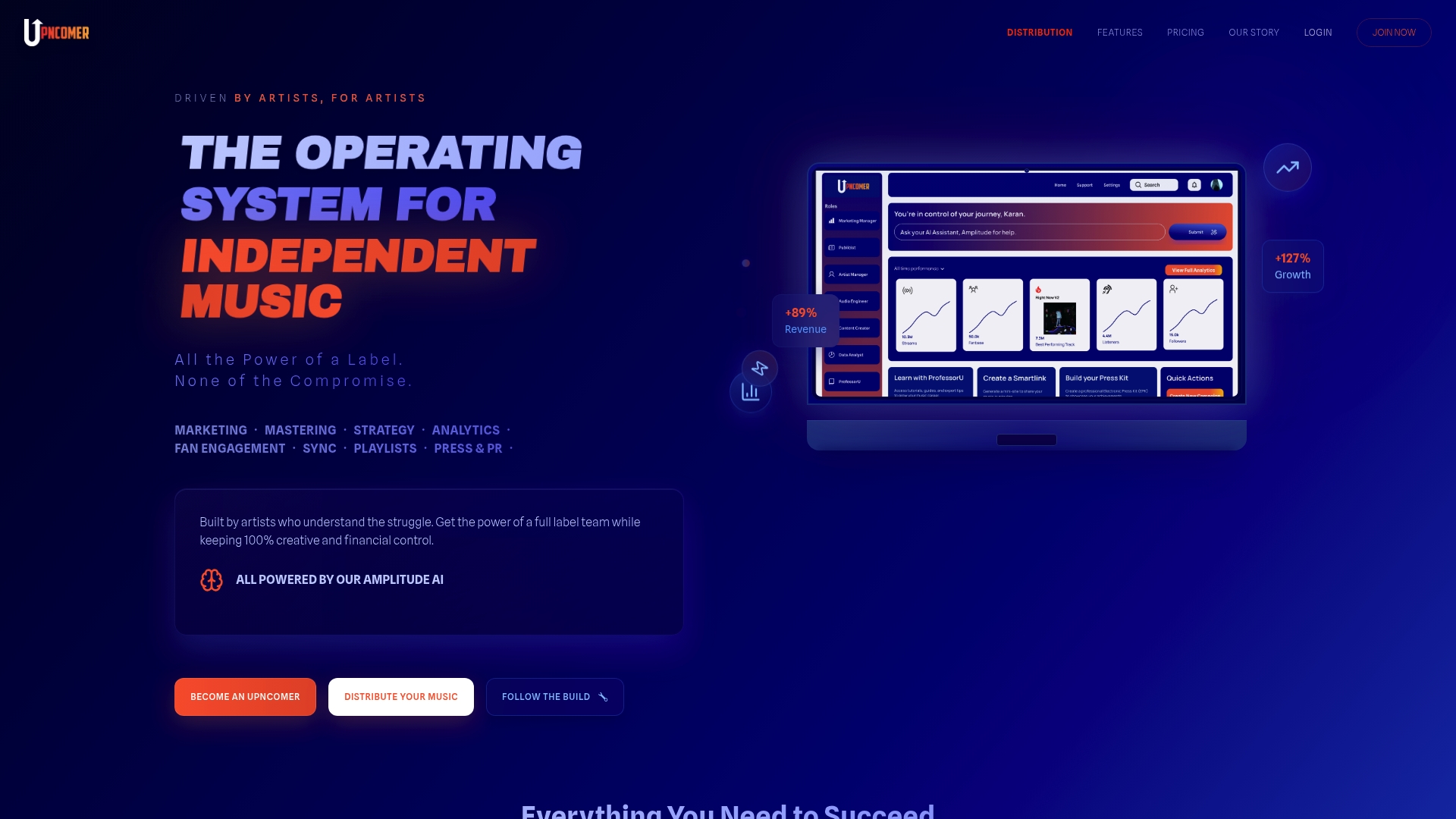
Growth Engine handles campaign orchestration, so your local ad tests and creator seeding pushes run from one dashboard instead of three separate ad accounts. Amplitude AI turns your streaming and social numbers into decisions you can actually act on, like which city to route your next tour through. Artist Manager keeps your tour contacts, venue notes, and fan lists in one searchable place instead of six phone notes. And Distribution ties your smart links and release timing directly to your promotion calendar, so a new single lands with a ticket-ready link already attached.
Fewer tools means faster decisions and one place to check performance instead of five logins to remember. If you’re ready to see what a unified system looks like for your next run of dates, check the plans on the UpNComer pricing page, which starts at $27 per month or $300 billed annually, or explore how distribution and smart links work together to support your next tour announcement.
Sources
- How to Get People to Actually Come to Your Shows (2026) | Tools 4 Music Blog | Tools 4 Music 2026
- Independent Artist Marketing Strategy 2026: The Complete Playbook | Slow Oak Studio
- Music Marketing for Indie Artists — The 2026 Guide | liminl.
- Concert Tour Advertising: How We Run Street-Level Campaigns Across 30 Cities | American Guerrilla Marketing
- Music marketing strategies | Berklee (2025)
FAQ
How far in advance should I start tour promotion?
Start a formal promotion push about six weeks before a local show, with a soft announcement even earlier if the date is confirmed and the ticket link is live.
How many creators should I seed for a tour announcement?
Aim for 20 to 40 nano and micro creators whose content categories naturally fit your sound, and treat them as ongoing collaborators rather than one-off posts.
What ad budget should I start with for a local show?
Start with $20 to $50 for a local test, and only scale toward larger monthly budgets once your cost per ticket proves the spend is working.
Does UpNComer help with tour promotion specifically?
UpNComer’s Growth Engine, Amplitude AI, and Artist Manager modules coordinate ad campaigns, audience data, and contact lists in one platform, and current pricing is listed on the UpNComer pricing page.
Should I run ads before I have any streaming momentum?
No. Ads amplify a signal that already exists, so validate saves, listens, and engagement organically first, then use paid spend to extend traction you can already see.