How to Write a Spotify Editorial Pitch for Indie Artists

Yes, you can pitch directly to Spotify editors, and the tool to do it is free inside Spotify for Artists. Submit one unreleased song per release, do it early, and your track gets considered for editorial playlists and automatically added to your followers’ Release Radar. That last part matters: the Release Radar addition is the floor, not the ceiling.
Your first three moves right now:
- Verify your Spotify for Artists account and confirm you have Admin or Editor access.
- Check that your distributor has delivered the release to Spotify (it must be in your Upcoming tab before you can pitch).
- Open Music > Upcoming in your Spotify for Artists dashboard and locate the unreleased track.
If your song isn’t showing in Upcoming yet, the pitch form won’t appear. Fix distribution delivery first, then come back to the pitch.
Key Takeaways
A strong Spotify editorial pitch combines accurate metadata, a clear 500-character hook-context-plan, early delivery, and targeted first-day promotion to create the listener signals editors actually weigh.
| Point | Details |
|---|---|
| Pitch at least 7 days early | Submit before the 7-day cutoff to secure your followers’ Release Radar addition automatically. |
| Aim for 3–4 weeks out | Best practice lead time avoids distributor ingestion delays and leaves room for pre-release promotion. |
| Fill every field accurately | Genre, mood, and culture tags route your pitch to the right editor; wrong tags mean the wrong team. |
| Write a 500-character hook-context-plan | State what it sounds like, why it matters, and one concrete promo action in under 480 characters. |
| Upncomer coordinates the full workflow | Distribution, Growth Engine, and Amplitude AI align delivery, promotion, and analytics for every pitch. |
Table of Contents
- What is a Spotify editorial pitch, exactly?
- Who can pitch, when to pitch, and what makes you eligible
- How to submit your pitch inside Spotify for Artists
- What to write in the 500-character pitch and which tags matter
- Your release timeline and promotion checklist
- Four fill-in-the-blank Spotify pitch templates
- Common mistakes, red flags, and scams to avoid
- What happens after you submit and how to track outcomes
- What actually raises your editorial chances, backed by data
- An indie marketer’s honest take on what actually moves the needle
- Upncomer makes the pitch process less painful
- Sources
- FAQ
What is a Spotify editorial pitch, exactly?
A Spotify editorial pitch is the official, free submission mechanism built into Spotify for Artists. It lets you send one unreleased song per release directly to Spotify’s human editorial team for playlist consideration. No middleman, no fee.
When you pitch at least 7 days before your release date, Spotify automatically adds the track to your followers’ Release Radar regardless of whether editors choose to playlist it. Editorial placement on curated playlists like Fresh Finds, Pollen, or genre-specific editorial lists is a separate outcome with no guarantee. Song pitches and video pitches are also handled separately, with different eligibility rules for each.
Who can pitch, when to pitch, and what makes you eligible
Eligibility checklist
Before you can submit, every item below must be true:
- Your Spotify for Artists account is verified.
- The release has been delivered by your distributor or label and appears in your Upcoming tab.
- The track is unreleased at the time of pitching.
- The release is not a compilation and you are not a featured artist on someone else’s track (featured-artist tracks cannot be pitched by the feature).
- You hold an Admin or Editor role on the Spotify for Artists account. Viewer-level access cannot submit or edit a pitch.
Only one official pitch exists per track. If a label also pitches the same release, their submission takes precedence over an artist-submitted one.
Timing: the 7-day rule and why 3–4 weeks is smarter
Spotify’s technical minimum lead time before release is to qualify for Release Radar. Miss that window and your followers won’t see the track in their personalized playlist on release day.
That said, experienced indie marketers recommend pitching 3–4 weeks out as best practice. Distributors sometimes take several days to ingest a release into Spotify’s system, and that ingestion time eats into your 7-day window without you realizing it. Pitching early also gives you time to coordinate ads, pre-save campaigns, and press outreach before the track goes live.
Timing callout: The lead time clock starts from when Spotify receives the delivered release, not from when you upload it to your distributor. Build in buffer.
How to submit your pitch inside Spotify for Artists
Follow these steps in order inside your dashboard:
- Log in to Spotify for Artists at artists.spotify.com.
- Click Music in the left navigation, then select Upcoming.
- Find the unreleased song you want to pitch and click on it.
- Select Pitch a song to open the pitch form.
- Fill in every field — genre, subgenre, mood, instruments, language, culture tags, recording location, and whether the track is a cover, collaboration, or remix.
- Write your 500-character pitch description in the free-text field (more on this below).
- Click Submit.
For video pitches, the flow is different. Go to Video & Visuals, find your eligible video (official music video or live performance), and select Pitch your videos. The video pitch UI only appears if the video meets Spotify’s eligibility criteria and has been delivered correctly.
Pro Tip: You can edit your pitch up to your release date, but don’t count on editors seeing last-minute changes. Lock in your final version at least 48 hours before release.
What to write in the 500-character pitch and which tags matter
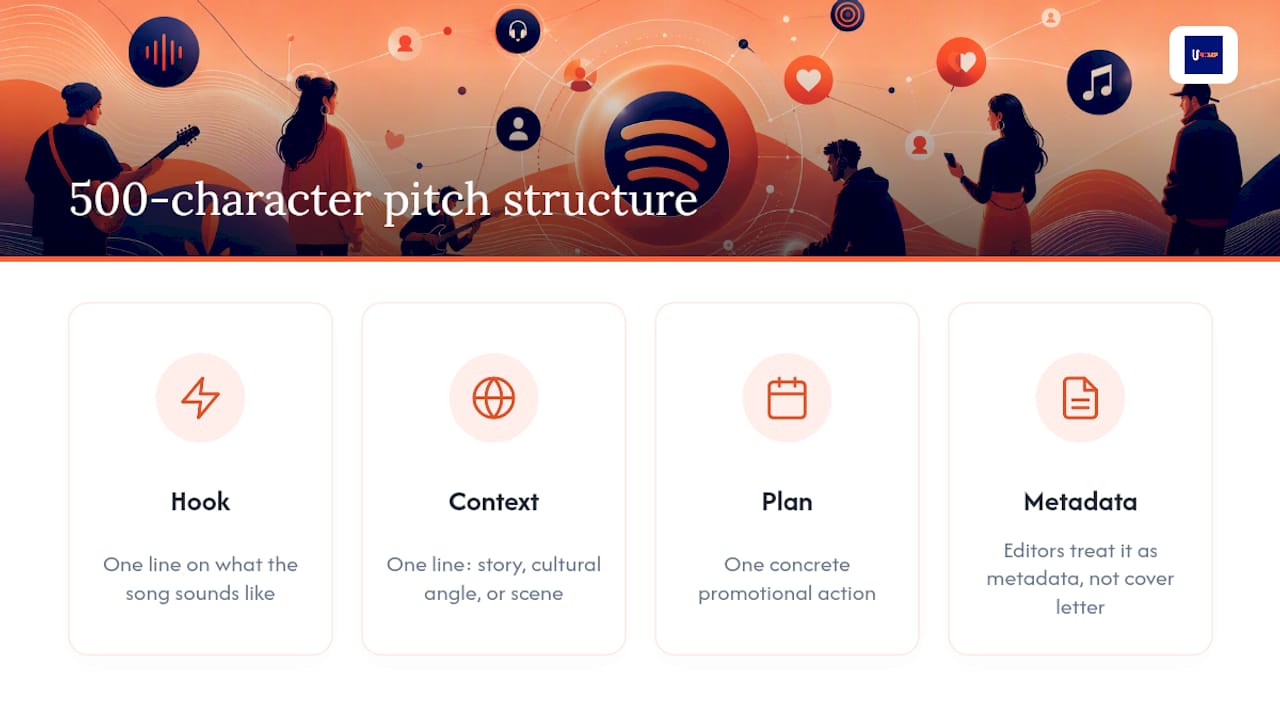
Editors treat the 500-character free-text field as metadata, not a cover letter. They scan it fast. The structure that works is hook, context, plan: one line on what the song sounds like, one line of context (story, cultural angle, or scene), and one concrete promotional action.
Field-by-field guidance
- Primary genre + up to 2 subgenres: Be accurate, not aspirational. Mislabeling routes your pitch to the wrong editorial team, and that team will pass on it immediately.
- Mood tag: Pick the mood a listener would actually use to describe the track, not the mood you want it to evoke.
- Lead instruments: List what’s actually prominent in the mix.
- Language: The language the lyrics are sung in, not your nationality.
- Culture and location tags: Name your hometown and current base. Editors prioritize local and regional fits, and a regional editor who recognizes your city is more likely to flag your track.
- Release context: Is this a debut? A follow-up to a track that performed well? Say so in one phrase.
- Marketing plan: One concrete action — a targeted ad campaign, a press feature, a sync placement, a college radio push.
Do this, not that
Do:
- Name two credible sonic comparisons (artists or scenes your track genuinely resembles).
- Include a specific local or cultural hook (“recorded live in New Orleans,” “draws from West African highlife”).
- Mention one real promotional action with a measurable output.
Don’t:
- Use vague adjectives like “emotional,” “powerful,” or “unique” with no supporting context.
- Overstate streaming numbers or claim hype you can’t back up.
- Leave the free-text field blank. Blank pitches are one of the most common reasons tracks are passed over.
Pro Tip: Read your 500-character pitch aloud. If it takes more than 20 seconds, it’s too long. Cut until every word earns its place.
Your release timeline and promotion checklist
Getting featured on Spotify editorial playlists isn’t just about the pitch form. The listener signals you create around release day matter too. Here’s how to sequence it:
3–4 weeks before release
- Confirm your distributor has delivered the release to Spotify and it appears in Upcoming.
- Finalize artwork, metadata, and ISRC codes before delivery.
- Draft and refine your 500-character pitch text and all tags.
- Lock in campaign assets: ad creatives, pre-save link, email copy, and social content.
1–2 weeks before release
- Submit your pitch (minimum 7 days out; earlier is better).
- Launch targeted pre-save campaigns to your most engaged listeners.
- Notify local press, blogs, and playlist curators outside of Spotify editorial.
- Brief your street team or superfans on release-day actions (save, share, add to library).
Release week
- Monitor your Release Radar addition in the Playlists tab.
- Pin the track to your This Is playlist if you’re eligible and it fits the project.
- Run release-day engagement plays: email your list, post across socials, and push short-form content through UrStudio.
Post-release
- Track saves, stream completes, and repeat listens inside Spotify for Artists.
- Use streaming analytics tools like Amplitude AI and Data Analyst to identify which listener segments responded and where geographic traction is building.
- Document what worked and apply it to your next playlist pitching strategy.
Four fill-in-the-blank Spotify pitch templates
Each template is built for the 500-character limit. Keep phrases short and specific. Pick the one track per release that best represents the project.
Template 1 — Debut single
Template 2 — Local/cultural focus
Template 3 — Collaboration or feature
Template 4 — Video pitch
Character tip: Aim for 400–480 characters so you have room to adjust without cutting substance. Prioritize 4–6 short, specific phrases over long sentences.
Common mistakes, red flags, and scams to avoid
Errors that kill your pitch
- Late delivery: If your track isn’t in Upcoming at least 7 days before release, you’ve already lost the Release Radar window.
- Wrong genre or mood tags: This is a routing problem, not a style preference. The wrong tag sends your pitch to an editor who doesn’t cover your sound.
- Empty free-text field: Editors have hundreds of pitches to review. A blank description tells them nothing and gets skipped.
- Pitching ineligible releases: Compilations and featured-artist tracks cannot be pitched through the standard tool.
- Overhyping without evidence: Claiming “this will be huge” with no data or promo plan reads as noise.
The paid placement scam
Warning: Spotify states clearly that no one can pay for editorial playlist placement. Any service claiming to guarantee an editorial add for a fee is lying. These services often mishandle your metadata, damage your distributor relationship, or simply take your money and disappear. Never pay for editorial placement. The only legitimate route is the free pitch tool inside Spotify for Artists.
Third-party services that claim special editorial access don’t have it. Spotify’s editorial team does not accept paid submissions, and no legitimate service can guarantee an editorial placement.
What happens after you submit and how to track outcomes
Once you submit, Spotify’s editorial team reviews your pitch before your release date. Here’s what to expect:
- Release Radar: If you pitched at least 7 days before release, your track will appear in your followers’ personalized Release Radar on release day. This happens automatically.
- Editorial playlists: Editors may add your track to a curated playlist, but there’s no notification that guarantees this. Check your Music > Playlists tab in Spotify for Artists after release.
- Different song selection: Editors sometimes playlist a different track from your release than the one you pitched. That’s their call, and it’s not a failure on your part.
- This Is playlist: If you’re eligible, pinning your new track to your This Is playlist increases its visibility to existing fans.
Metrics to monitor post-release
- Saves and save rate: The clearest signal of listener intent.
- Stream completes: Tracks that listeners finish signal quality to Spotify’s algorithm.
- Repeat listens: A strong indicator of superfan behavior.
- Playlist reach and source breakdown: Available in your Spotify for Artists dashboard; shows which playlists drove streams.
- Geographic listener data: Use music analytics tools to identify where traction is building so you can target follow-up promotion.
Reality check: Editorial pitching is one input in a larger system. Editors also factor in listener data signals when evaluating tracks. A pitch with strong early saves and completes carries more weight than one with no surrounding activity.
What actually raises your editorial chances, backed by data
Editors don’t work in a vacuum. They combine human judgment with listener data, which means your pitch and your promotion strategy are connected. Here’s what to prioritize:
- Accurate metadata and tags: The single highest-leverage action before you submit. Wrong tags mean the wrong editor sees your pitch.
- Clear hook-context-plan pitch text: Editors scan fast. A pitch that answers “what does it sound like, why does it matter, and what’s the plan?” in under 480 characters stands out.
- Early delivery: Aim for 3–4 weeks out to avoid ingestion delays and give yourself time to build pre-release momentum.
- Strong first-day listener signals: Saves, completes, and repeat listens on day one signal to both editors and Spotify’s algorithm that the track has pull. Targeted promotion to your most engaged listeners creates these signals.
- Multi-channel promotion: Email, social, short-form video, and targeted ads all feed the listener activity that editors see. Relying only on the pitch form is leaving signal on the table.
Upncomer’s Growth Engine, Amplitude AI, and Data Analyst modules map directly to these priorities: coordinating pre-release ad campaigns, surfacing which listener segments to target, and tracking the post-release metrics that tell you what’s working. The Distribution module also helps you deliver releases on time and avoid the ingestion delays that cost artists their Release Radar window.
The honest truth about editorial volume: Spotify editors receive thousands of pitches per week. A technically correct pitch with a clear story and real promotional activity behind it is already in the top tier. You don’t need a label. You need accuracy, timing, and a plan.
An indie marketer’s honest take on what actually moves the needle
The pitch form is not where most artists lose. They lose in the two weeks before it.
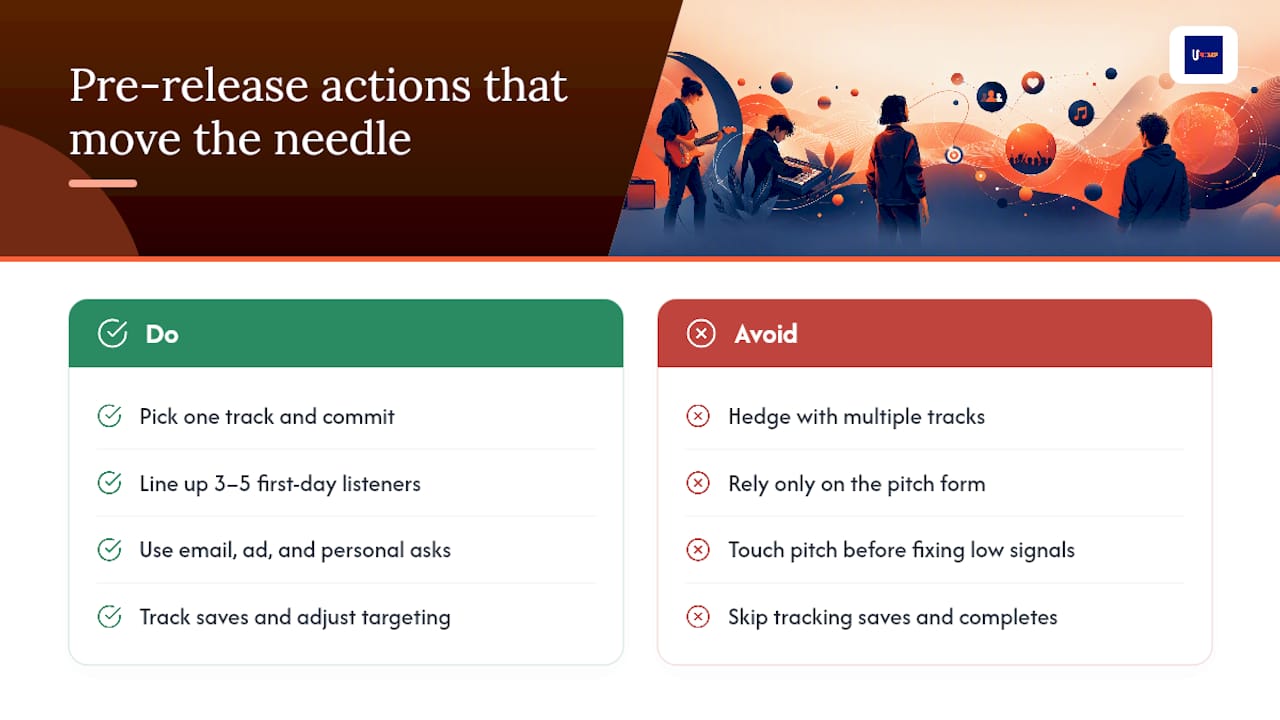
The artists who see consistent editorial traction do two things differently. First, they pick one track per release and commit to it fully — no hedging, no “we’ll see which one performs.” One track, one pitch, one focused campaign. Second, they line up three to five targeted first-day listeners before the release: a superfan email segment, a small targeted ad to fans of their two sonic comps, and a personal ask to their most engaged social followers to save the track on day one. Those early saves and completes are the listener signals that make a pitch land harder, and they’re entirely within your control.
Track those saves and completes in your streaming analytics dashboard. If they’re low, adjust your targeting on the next release before you touch the pitch form.
Upncomer makes the pitch process less painful
Most indie artists spend more time managing the logistics around a pitch than writing the pitch itself. Upncomer is built to fix that.
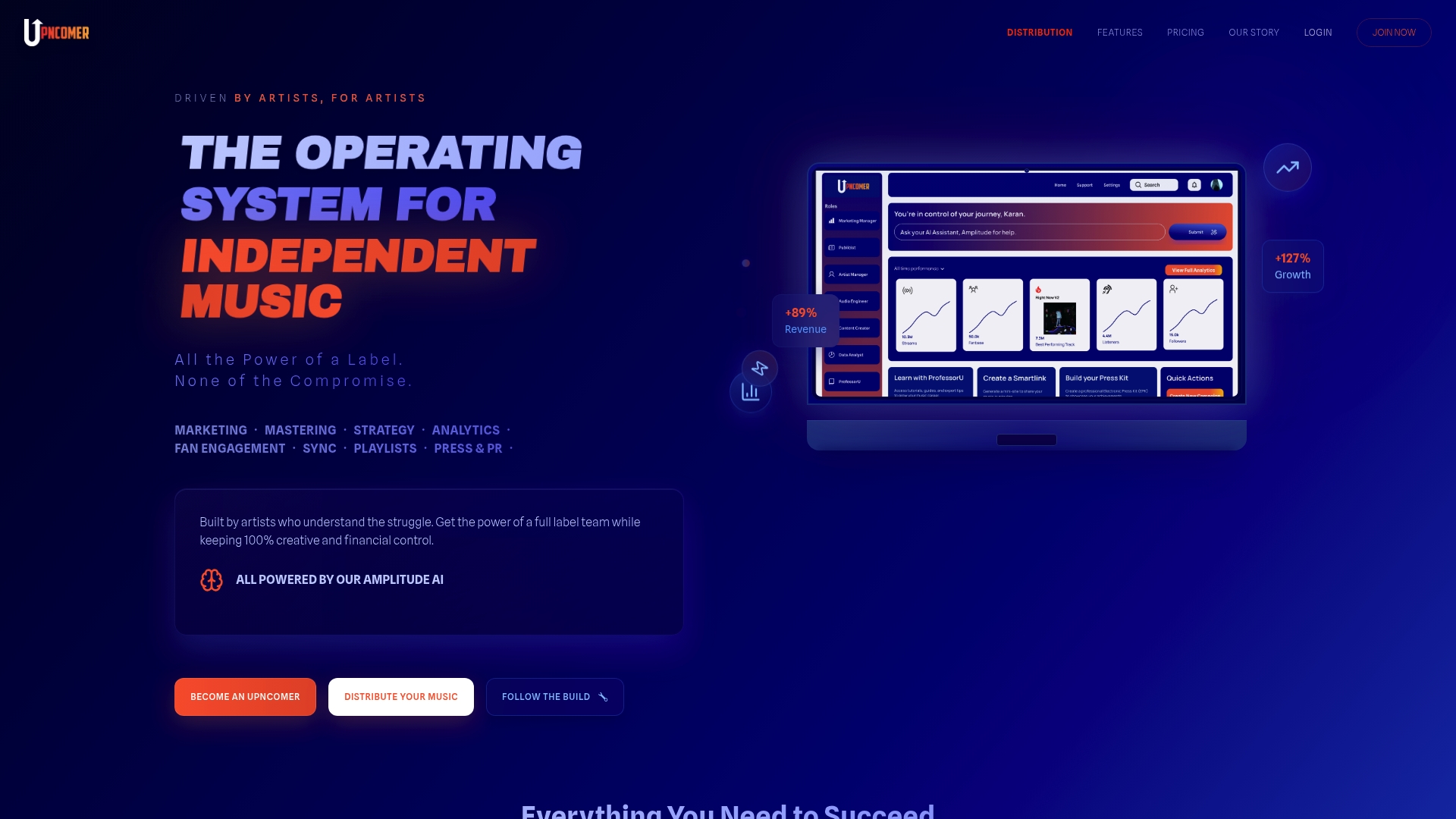
The Distribution module gets your release delivered on time so you never miss the 7-day window. Growth Engine coordinates your pre-release ad campaigns and pre-save flows. Amplitude AI surfaces which listener segments are most likely to save and complete your track on day one. Data Analyst tracks the post-release metrics that tell you whether your pitch strategy is working. And Publicist helps you line up the press and playlist outreach that creates the surrounding noise editors notice.
You get one platform instead of five separate tools, and every module feeds the same goal: a pitch that lands with real listener signals behind it. See what Upncomer can do for your next release and check the latest platform updates at Upncomer community updates.
Sources
- Pitching music and videos to Spotify playlist editors - Spotify
- Playlisting – Spotify for Artists
- Spotify for Artists: how to pitch your song to editorial playlists | Playlist Atlas
FAQ
What is a Spotify editorial pitch?
A Spotify editorial pitch is the free, official submission tool inside Spotify for Artists that lets verified artists submit one unreleased song per release to Spotify’s human editorial team for playlist consideration. Pitching at least 7 days before release also adds the track to followers’ Release Radar automatically.
How do you pitch to editors on Spotify?
Log in to Spotify for Artists, go to Music > Upcoming, select your unreleased track, click “Pitch a song,” fill in all fields including genre, mood, culture tags, and the 500-character description, then submit. Only Admin and Editor roles can submit or edit a pitch.
How long does it take to pitch Spotify editorials?
The pitch form itself takes 10–15 minutes to complete, but the real timeline is about delivery: you need to submit at least 7 days before your release date, and best practice is 3–4 weeks out to account for distributor ingestion time and pre-release promotion.
How many characters is a Spotify editorial pitch?
The free-text description field allows 500 characters. Aim for 400–480 so you have room to refine without cutting substance, and structure it as a hook, context, and one concrete promotional plan.
Can you pay to get on a Spotify editorial playlist?
No. Spotify states that no one can pay for editorial playlist placement, and any service claiming to guarantee an editorial add for a fee is a scam. The only legitimate route is the free pitch tool inside Spotify for Artists.