Pitch in 7 Days to Get Release Radar Placement for Indie Artists
Yes, you can get on Release Radar, and it isn’t luck. Every eligible release from an artist you follow lands in that playlist automatically, but prominence depends on two things: pitching your song at least seven days before release and generating early, concentrated engagement from real followers. Nail the timing and the follower signal, and the rest of this playbook shows you how to make Release Radar work harder for your next drop.
TL;DR:
- Releasing at least seven days in advance and generating early, focused engagement are crucial for securing early Release Radar placement.
- Metadata accuracy, correct artist credits, and timely delivery to Spotify are essential to avoid missing the playlist’s initial week.
- Concentrating streams, saves, and playlist adds within the first 72 hours significantly boosts the chances of proper algorithmic pickup.
- Regularly checking Release Radar inclusion through Spotify for Artists helps artists monitor and react to early engagement patterns.
- Building and warming a small, active follower base outweighs large, inactive audiences for better Release Radar visibility.
Table of Contents
- What Is Release Radar and How Does It Actually Work?
- What Are the Eligibility Rules for Release Radar Placement?
- How Do You Prepare a Release for Release Radar Placement?
- What Should You Do in the First 72 Hours After Release?
- How Do You Check If Your Song Made Release Radar?
- Why Didn’t My Track Show Up on Release Radar?
- How UpNComer Turns This Playbook Into a Repeatable Workflow
- What Should Independent Artists Prioritize Right Now?
- Get Your Next Release Release Radar Ready
- Sources
- FAQ
What Is Release Radar and How Does It Actually Work?
Release Radar refreshes every Friday and pulls almost entirely from artists a listener already follows, with a smaller slice reserved for algorithmic discovery. It’s built to surface what’s new, not what’s evergreen, which is why the playlist prioritizes releases from roughly the last two to four weeks before rotating them out.
That time sensitivity is the whole game. A song that gets a slow, spread-out trickle of streams over a month behaves differently in Spotify’s eyes than one that gets a concentrated burst in the first few days. Release Radar rewards the burst.
It’s worth separating this from Discover Weekly, which artists often lump together with Release Radar. Discover Weekly is a Monday playlist built entirely around algorithmic taste matching, pulling from artists a listener has never followed. Release Radar is about your existing audience. If Discover Weekly is cold outreach, Release Radar is Spotify handing your new song directly to the people who already follow you, amplified by Home tab placement and Friday release emails. That distinction should shape where you spend your pre-release energy: growing and warming followers matters more here than chasing algorithmic luck.
What Are the Eligibility Rules for Release Radar Placement?
Spotify’s own guidance is specific, and most artists who miss Release Radar broke one of these rules without realizing it. Spotify Support states plainly that you need to pitch your song at least seven days before release day to be considered for Release Radar in its first week. Miss that window and your track can still reach followers eventually, but you lose the crucial early-week placement that drives momentum.
The formal rules break down like this:
- Delivery timing: Your distributor must deliver the release to Spotify at least seven days before its street date. Three to four weeks ahead is safer, since distributor processing times vary.
- Artist credit: You need to be listed as a main or featured artist. Remixer-only credits typically don’t qualify a track for that artist’s own Release Radar.
- One song per week: Spotify surfaces only one song per artist per listener per week, even if you release multiple tracks the same Friday.
- Playlist window: A track can appear in Release Radar for up to four weeks after release, with visibility strongest early on.
- Re-releases and new ISRCs: A re-release, remaster, or deluxe edition needs correct new ISRC handling to be treated as fresh content rather than a duplicate.
Beyond Spotify’s own rules, most eligibility failures trace back to distributor mapping. Verify your artist URI is correctly linked in your distributor’s dashboard, confirm territory availability matches where your fans actually stream, and lock your final metadata (title, featured artists, ISRC) before delivery. Metadata changes after delivery are a common, avoidable cause of Release Radar no shows.
How Do You Prepare a Release for Release Radar Placement?
The pre-release window is where most of the real work happens, and the order matters. Doing these out of sequence is how artists end up pitching a song that isn’t fully delivered yet, or running pre-save ads to an audience that never converts to a follow.
- Lock distribution and metadata four weeks out. Schedule your release with your distributor early and finalize title, credits, and ISRC before delivery. This is also when to double check territory settings.
- Submit your Spotify for Artists pitch at least seven days before release. Earlier is better. A well-written pitch that accurately describes genre, mood, and instrumentation also helps beyond Release Radar, since the same pitch feeds editorial consideration.
- Turn casual listeners into followers. A pre-save link is only half the job if it doesn’t push people to hit follow. Route pre-save campaigns through funnels that end on your Spotify profile with a clear follow prompt, not just a save confirmation.
- Re-warm your existing follower base. If your last release was months ago, some of your followers have gone quiet. A short reactivation post or email a week before release reminds them you exist before the algorithm needs them to engage.
- Run small, targeted pre-save ads to seeded audiences. A tight ad set aimed at people who already stream artists similar to you beats a broad, cheap campaign every time. Quality of the click matters more than volume here.
- Confirm release time and credit every collaborator correctly. Proper featured-artist credits unlock a second (or third) pool of followers who’ll see the track in their own Release Radar.
- Prep release-day content in advance. Short-form video, an email or text blast to your most engaged fans, and a smart link ready to go the moment the clock strikes midnight all reduce the lag between release and first stream.
Pro Tip: Don’t wait until release week to write your Spotify for Artists pitch. Draft it two to three weeks out, then revisit it once your artwork and final mix are locked, since a rushed pitch written the night before delivery is the fastest way to submit generic, forgettable copy.
What Should You Do in the First 72 Hours After Release?
Release Radar cares about when engagement happens, not just how much. A track that earns 3,000 streams spread across three weeks tells a very different story than one that earns 3,000 streams in the first three days. Concentrate everything you can into that opening window.
- Push saves before streams, when possible. Saves are a stronger intent signal than a passive play, and a healthy save-to-stream ratio tells Spotify people didn’t just hear the song, they wanted to keep it. Ask directly in your captions and stories, in a natural way (“hit save if this one’s stuck in your head”) rather than a generic “stream now.”
- Fight the skip rate. Your first 15 seconds decide whether a listener sticks around or bounces. If your intro is slow, consider whether the version going to playlists should get straight to the hook.
- Coordinate any friendly playlist adds to land in the same window as your release, not scattered across the week. Fragmented timing spreads your signal thin instead of stacking it.
- Favor niche-community placements over broad exposure. A curator playlist for your specific micro-genre, even a small one, tends to produce listeners who complete plays and save, which matters more than a large playlist full of low-intent traffic.
Industry heuristics floating around the independent artist world suggest a directional benchmark of roughly 2,500 streams and 250 saves within the first one to three weeks as a rough marker tied to stronger algorithmic pickup. Treat that as a compass, not a finish line. Spotify has never published an official minimum, and industry analysis pointing to early Release Radar appearances within the first 48 hours consistently ties back to stronger first-week streaming overall, which is the outcome you’re actually chasing.
How Do You Check If Your Song Made Release Radar?
Spotify for Artists gives you a direct look at this, and checking it should become a Friday-morning habit for the first month after every release.
- Open Spotify for Artists and go to your song’s page, then click the Playlists tab to see every editorial and algorithmic playlist currently carrying the track, including Release Radar.
- Check the source of streams breakdown under song stats to see what share of plays came from Release Radar specifically versus your profile, radio, or other playlists.
- Remember the refresh happens Friday according to each listener’s local time zone, so don’t panic if your numbers look thin a few hours after midnight UTC. Give it a full day before drawing conclusions.
- Look at the ratio between saves and follows versus raw streams. A spike driven mostly by your own follower base shows up as strong Release Radar attribution alongside a healthy follow rate; a spike from algorithmic discovery instead shows up more in Discover Weekly or Radio, with less follower-driven attribution.
Why Didn’t My Track Show Up on Release Radar?
If Friday came and went with no Release Radar placement, work through these in order, since they cover the vast majority of cases.
- Check your delivery timestamp with your distributor. If it landed less than seven days before release, that alone explains a missed first week. Reschedule your next release with a longer buffer.
- Audit your metadata. Confirm your artist URI is correctly mapped, your ISRC is unique and correctly assigned, featured-artist credits are accurate, and your territories include where your fans actually are.
- Check your artist credit type. If you’re listed only as a remixer, that generally excludes the track from counting toward your own Release Radar. A re-release or remaster needs its own new ISRC to count as new content.
- Look at your follower activity. A large but dormant follower base gives the algorithm little to work with. Re-engagement before release matters more than the raw follower count.
- Escalate if everything checks out. Document your delivery date, pitch submission date, and metadata, then contact your distributor’s support team and, if needed, Spotify for Artists support directly with that documentation in hand.
How UpNComer Turns This Playbook Into a Repeatable Workflow
Every step above is manageable by hand for one release. It gets harder to run consistently across every release, every quarter, without something tracking the moving pieces for you.
UpNComer’s Distribution module handles scheduling and ISRC management on the delivery side, so the seven-day (or earlier) delivery window isn’t something you’re tracking in a spreadsheet. On the promotional side, Growth Engine and Content Creator build the pre-save funnels and smart links that turn casual clicks into actual follows, and the same Growth Engine tools run the targeted ad campaigns aimed at listener clusters similar to your sound.
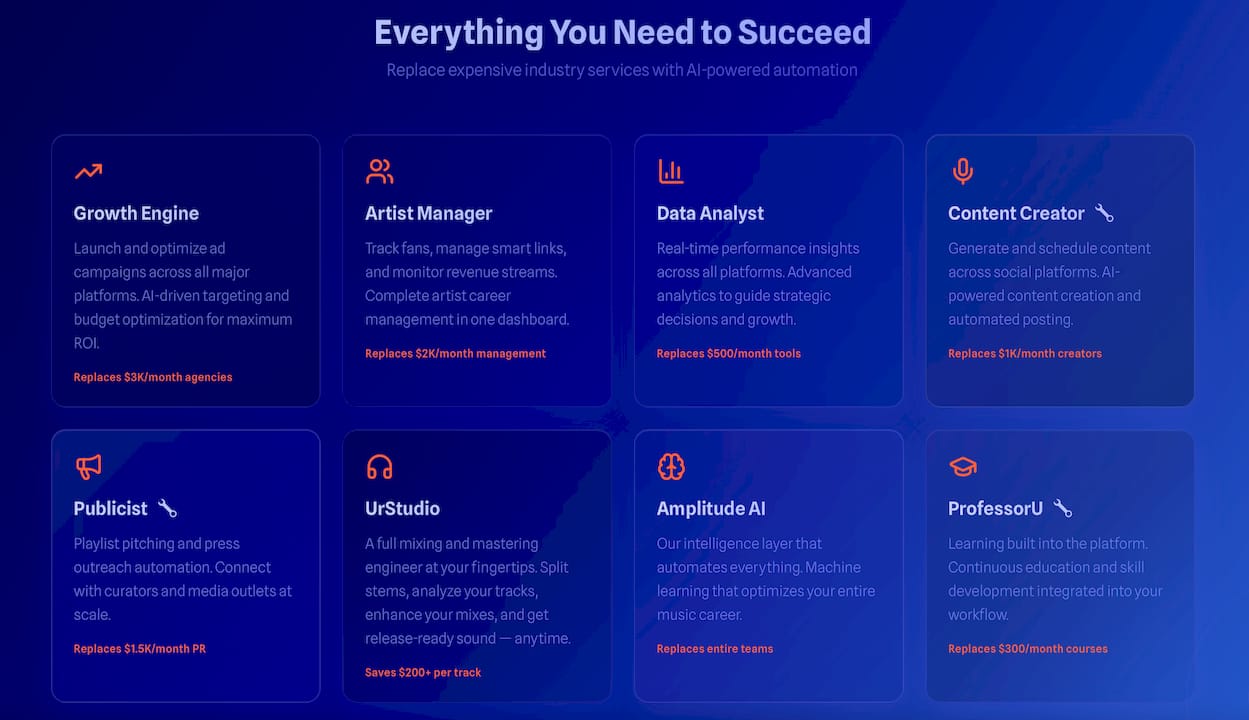
Once the release is live, Data Analyst and Amplitude AI track follower activity, save rates, and streaming source data in one dashboard instead of you toggling between Spotify for Artists tabs and a notes app.
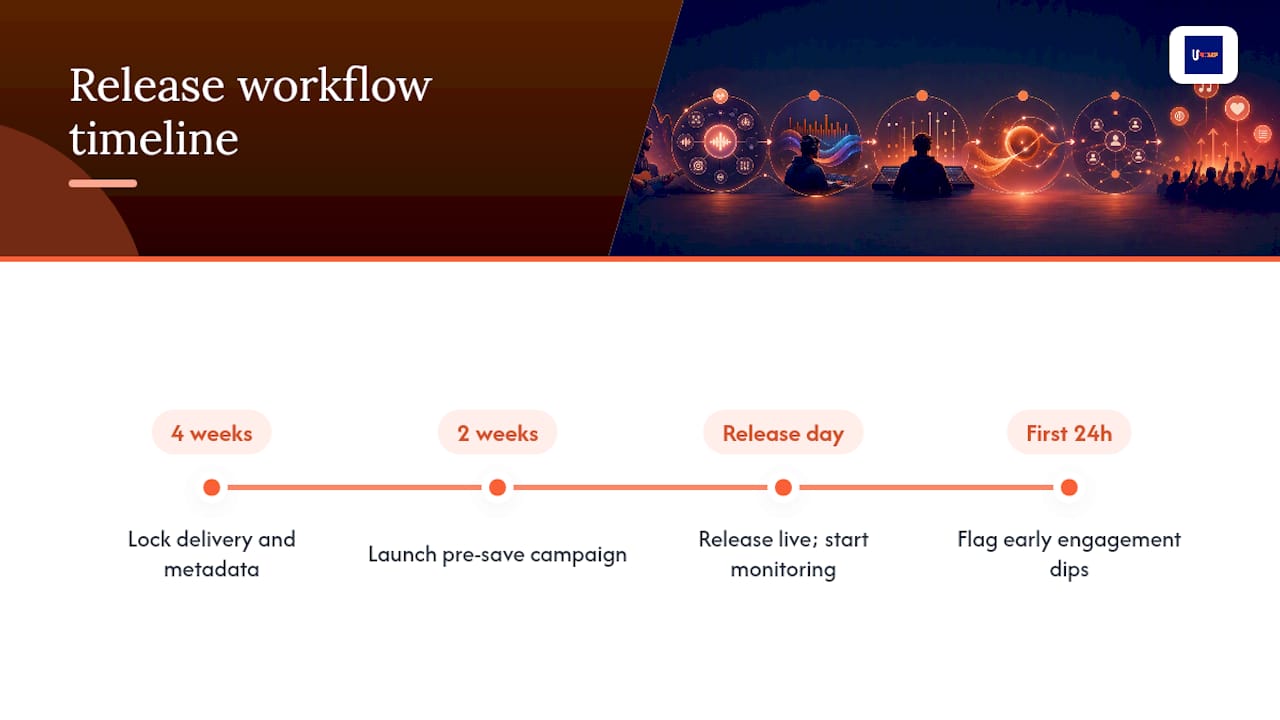
A realistic workflow: four weeks out, Distribution locks your delivery date and metadata. Two weeks out, Growth Engine launches your pre-save campaign to a seeded audience. Release day, Amplitude AI flags early engagement dips so you can react inside the first 24 hours instead of finding out on Monday.
Pro Tip: Set a calendar trigger tied to your distribution date, not your release date. If delivery slips, everything downstream, including your pitch window, slips with it.
What Should Independent Artists Prioritize Right Now?
Most artists chase monthly listener counts. That number is close to useless for Release Radar. What matters is how many of your followers are active, meaning they’ve streamed you recently and are likely to engage the moment a new release drops. I’d rather see an artist with 2,000 warm followers than 20,000 cold ones.
Pick a cadence you can actually sustain, whether that’s every six weeks or every quarter, and use each release to test one variable: pitch timing, save-ask phrasing, or ad targeting. Track saves and early completion rate religiously. That discipline compounds faster than any single viral moment.
— Karan
Get Your Next Release Release Radar Ready
Everything in this playbook, from locking metadata to warming followers to catching a dip in saves before it costs you the week, is easier when it lives in one place instead of six browser tabs and a spreadsheet. UpNComer brings distribution scheduling, pre-save funnels, targeted ad campaigns, and real-time follower analytics into a single workflow, so the tactics above stop being a checklist you forget under deadline pressure and start being something the platform tracks with you.
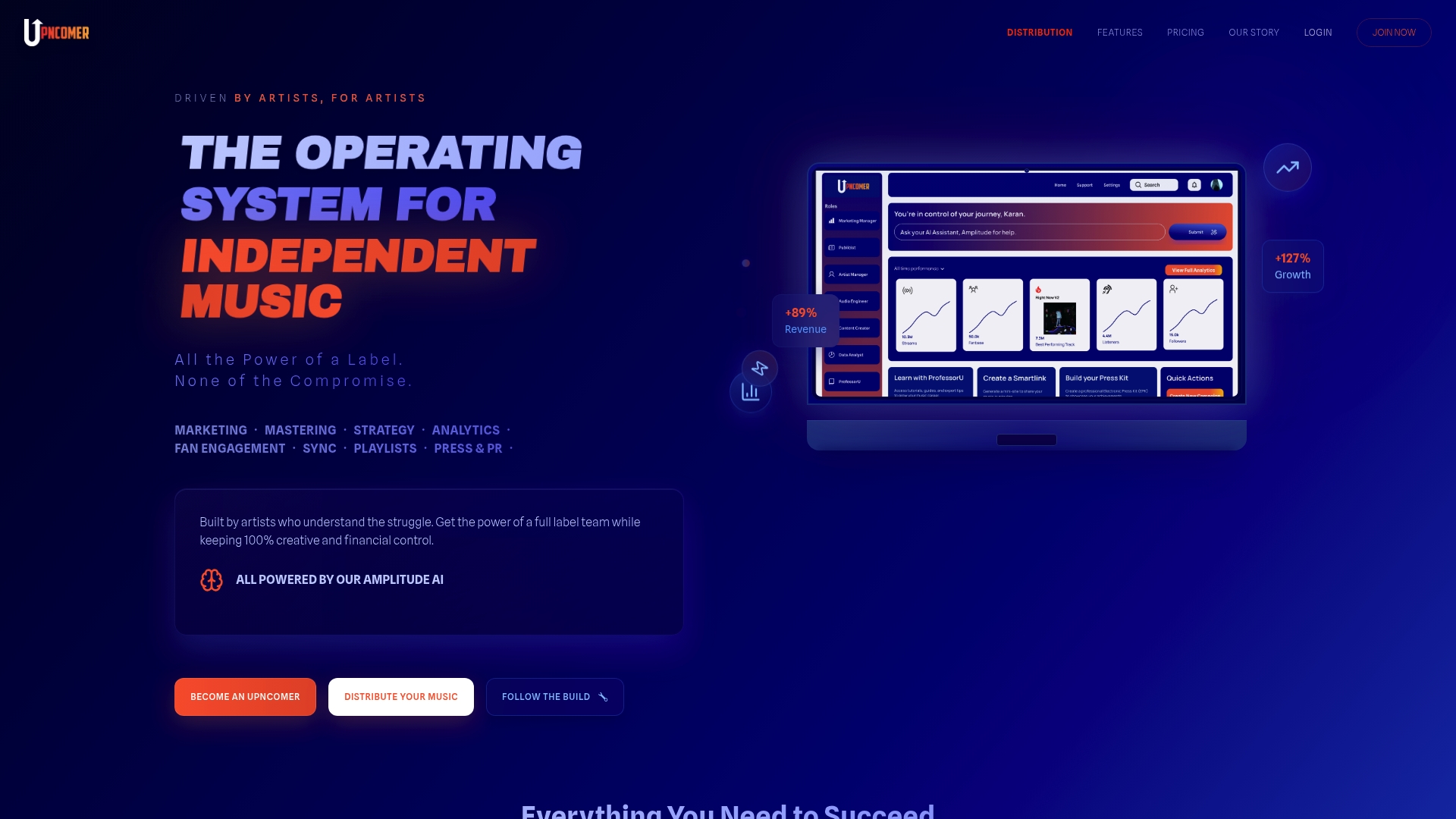
If you’re distributing independently right now, UpNComer Music Distribution handles delivery scheduling and ISRC management with a 6% royalty split and no subscription fee attached to distribution itself. For the full toolkit, including Amplitude AI, Growth Engine, and Data Analyst, UpNComer Pro runs $27 per month or $300 per year. Set up your next release inside UpNComer and give your Release Radar pitch the timing it actually needs.
Sources
- Getting music on Release Radar — Spotify Support
- Promoting new releases to your followers — Spotify for Artists blog
- Discovery playlists: Release Radar control updates — Spotify Newsroom
- How to Trigger Discover Weekly & Release Radar | MusicPulse
FAQ
Does Every Artist Get on Release Radar?
Every eligible release from an artist with active followers can appear, but appearance isn’t automatic if delivery misses the seven-day window or metadata is broken. Artists with very few or dormant followers may see minimal Release Radar reach even when technically eligible.
How Many Streams on Spotify Does It Take to Make $1,000,000?
Streaming payouts vary by market, subscription tier, and distributor deal, so there’s no single official per-stream rate Spotify publishes. This question sits outside Release Radar mechanics specifically, since payout math depends on your distribution agreement rather than playlist placement.
What Time Does Release Radar Come Out?
Release Radar refreshes every Friday, timed to each listener’s local time zone rather than one global moment. That’s also why checking your Spotify for Artists Playlists tab a few hours after midnight can look thin before the full day’s data comes in.
How Do You Get Into Release Radar?
Pitch your song through Spotify for Artists at least seven days before release, ideally three to four weeks ahead for a safety buffer, and make sure your delivery, credits, and ISRC are locked before that pitch goes in. Beyond the technical requirements, converting listeners into actual followers and driving concentrated saves in the first 72 hours are what push a track from merely eligible to prominently placed.