QR Codes for Music: A Practical Guide for Independent Artists
Use a smart, dynamic QR code that detects the scanner’s device and routes them to the right streaming app. That’s the single best approach for any independent artist sharing music through print or digital materials.
Get started in the next 10 minutes:
- Copy your Spotify, Apple Music, or SoundCloud link (or upload your MP3 to a hosting tool)
- Create a dynamic QR code using a generator like QRSprint or QRKit
- Scan it on your phone to confirm it opens the right destination before you print anything
That’s it. Everything below helps you do it better, smarter, and with real tracking behind it.
Key Takeaways
Smart, dynamic QR codes are the most effective way for independent artists to share music through physical and digital materials because they route by device, stay editable after printing, and provide the scan analytics needed to measure and improve every campaign.
| Point | Details |
|---|---|
| Use smart-routing dynamic QR codes | They detect device type and route fans to their preferred streaming app automatically. |
| Test before printing anything | Scan on multiple devices and OS types before committing to a print run. |
| Size, contrast, and quiet zone matter | Minimum 2.5 cm × 2.5 cm, high contrast, and an intact quiet zone prevent scan failures. |
| Track scans to improve campaigns | Monitor OS, location, and timestamps to cut weak placements and double down on winners. |
| UpNComer connects the full workflow | Distribution, Growth Engine, Data Analyst, and Amplitude AI run your QR campaign in one place. |
Table of Contents
- What type of QR code works best for music promotion?
- How to create a music QR code step by step
- Design and placement rules that actually get your code scanned
- What to track and why dynamic QR codes change the game
- Rights, permissions, and privacy before you publish
- Real-world campaign examples you can copy right now
- A complete workflow: create, route, track, and act
- Why this QR-first approach actually works for independent artists
- UpNComer makes smart links and QR tracking stupidly easy
- Sources
- FAQ
What type of QR code works best for music promotion?
Not all music QR codes are built the same, and picking the wrong type costs you listeners. Here’s a clear breakdown of your four main options.
Streaming link QR points directly to a track or playlist on Spotify, Apple Music, or SoundCloud. It’s the fastest to set up, but it locks fans into one platform. If your listener doesn’t have that app installed, they hit a dead end.
Hosted-audio QR links to an MP3 or WAV file you’ve uploaded to a hosting tool. When scanned, the audio plays inline in the mobile browser without requiring any app. This works well for exclusive downloads, demos, or content you want to gate.
Platform-native codes (Spotify Codes) are Spotify’s proprietary scannable tags that open content directly inside the Spotify app. They’re clean and on-brand, but they only work for Spotify users. No cross-platform reach.
Smart-routing QR is the strongest option for most artists. It detects the scanner’s device and routes iOS users to Apple Music, Android users to Spotify or regional apps, and desktop users to a web player. You can edit the routing rules after printing, so your physical materials never go stale.
| Type | Updateable | Analytics | Best For |
|---|---|---|---|
| Streaming link QR | No (static) | None | Quick digital shares |
| Hosted-audio QR | Yes (dynamic) | Scan data | Demos, exclusive downloads |
| Spotify Code | No | None | Spotify-only campaigns |
| Smart-routing QR | Yes (dynamic) | Full scan data | Posters, merch, press kits |
For most release campaigns, smart-routing wins. For a free MP3 giveaway at a show, hosted-audio is the move.
How to create a music QR code step by step
Follow this in order. Skipping steps, especially testing, is how artists end up with broken codes on 500 printed flyers.
-
Choose your destination. Decide whether you’re linking to a streaming URL, a hosted audio file, or a smart-link landing page. If you want cross-platform reach, build a smart-link page first and point the QR at that.
-
Pick a dynamic QR generator. Use a tool that supports dynamic codes and provides analytics. iCheckQR supports MP3, WAV, and public streaming links from Spotify, SoundCloud, and Bandcamp. QRKit and Abundera both support hosted audio with scan tracking.
-
Create the dynamic QR. Paste your URL or upload your audio file. Select “dynamic” mode, not static. This gives you an editable short URL behind the code.
-
Add branding. Drop in your logo, match the code’s colors to your release artwork, and add a frame with a call-to-action like “Scan to Listen.” A code that looks like part of your visual identity gets scanned more than a plain black square.
-
Download the right file format. Use SVG for anything going to print (posters, vinyl sleeves, merch). PNG works for digital use. Dynamic audio QR generators typically support PNG, SVG, and PDF downloads, so you’re covered for both.
-
Test before you commit to print. Scan the code with your own phone, then test on a second device with a different OS. Try both the native camera app and a QR scanner app.
-
Prepare for production. Confirm the quiet zone (the white border around the code) is intact, the minimum print size is at least 2.5 cm × 2.5 cm, and the contrast between the code and background is high enough to scan reliably.
Pro Tip: Always use a smart-link landing page as your QR destination rather than a raw streaming URL. If a platform changes its URL structure or you switch distributors, you update the smart link once and every printed code in the world still works.
Design and placement rules that actually get your code scanned
A QR code that nobody scans is just decoration. These rules close the gap between printing and listening.
Design fundamentals
Contrast is non-negotiable. Dark module on a light background (or the reverse with a high-contrast inversion) scans reliably. Avoid placing the code over a busy photo or gradient. The quiet zone, the blank margin surrounding the code, must be at least four modules wide. Shrink it and scanners fail.
Your logo can sit in the center of the code without breaking it, because QR codes have built-in error correction. Beyond that, you’re eating into the data modules and risking scan failures.
The CTA matters more than most artists realize. “Scan to Listen” outperforms a bare code because it tells the person what happens next. Add it as a line of text directly above or below the code, in the same font family as your release artwork.
Placement that converts
- Gig posters: Position the code at eye level, lower third of the poster, away from folds or staple points
- Merch tags: Hang tags on T-shirts, hoodies, and hats are prime real estate for a bonus track or exclusive content link
- Vinyl inner sleeves: Fans who buy vinyl are already invested; a QR linking to a digital download or behind-the-scenes content rewards that
- Press kits: A code linking to your demo reel or EPK audio saves a journalist from hunting for your music
- Venue slides: A full-screen “Scan to Follow” slide during your set captures fans while the energy is highest
Pro Tip: Print a proof at actual size before your full run. Test it under the lighting conditions where it will actually be displayed: a dim venue, outdoor daylight, and under fluorescent store lighting all scan differently. What looks great on screen can fail in print.
What to track and why dynamic QR codes change the game
Static QR codes are blind. You print them, fans scan them, and you have no idea what happened. Dynamic QR codes track scans by location, operating system, and count, and you can update the destination without touching the printed code. For any serious release campaign, that’s the difference between guessing and knowing.

Here’s what to measure and what to do with each metric:
| Metric | What It Tells You | How to Use It |
|---|---|---|
| Total scans | Overall campaign reach | Benchmark against previous releases |
| Unique devices | Actual individual listeners reached | Separate from repeat scans to gauge true reach |
| OS breakdown (iOS vs Android) | Platform preference of your audience | Prioritize the dominant platform in ad spend |
| Location (country/city) | Where your fans are physically | Target local shows, regional playlist pitching |
| Scan timestamps | Peak engagement windows | Schedule social posts and ad boosts around them |
| Referral context | Which placement drove the scan | Cut underperforming placements, double down on winners |
Pairing scan data with streaming analytics gives you a complete picture: who scanned, where they came from, and whether they actually listened.
A note on privacy: Collect only what you need. If your QR landing page has a sign-up form, be transparent about what you’re collecting and why. Link to your privacy policy, and avoid collecting sensitive personal data beyond email and location consent. Most dynamic QR platforms process scan data under their own terms, so review those before committing to a tool.
Rights, permissions, and privacy before you publish
This is the checklist most artists skip. Don’t.
Confirm you own or have rights to the recording. If you recorded through a label deal or used a sample, check your distribution agreement before linking publicly. Some contracts restrict where and how you can share audio.
Check your distributor’s terms. Platforms like DistroKid, TuneCore, and UpNComer’s Distribution service each have policies about direct audio sharing outside their ecosystem. Smart links that route to streaming platforms are almost always fine; hosting raw audio files may require additional rights clearance.
Confirm the linked content is publicly accessible. A private SoundCloud track or a Spotify pre-save that’s expired will break your QR. If you’re using cloud-hosted audio, set the file’s sharing to public before generating the code.
Update your landing page privacy text. If your QR routes to a landing page that collects emails or uses tracking pixels, add a one-line disclosure. Something like “We collect scan data to improve our campaigns” keeps you compliant with GDPR, CCPA, and similar frameworks depending on your audience’s location.
Document your source permissions. Keep a simple record of where each recording came from, who owns it, and what rights you have. If a platform flags your content, you’ll need that paper trail fast.
Real-world campaign examples you can copy right now
These aren’t hypotheticals. Each one is a setup you can replicate in an afternoon.
Gig poster single announcement. Print a smart-routing QR on your next show poster linking to your newest single. Fans scan it on the way to the venue, the code routes them to their preferred app, and you pick up streams before the set even starts. Run it for two weeks and check location data to see which neighborhoods drove the most scans.

Merch tag bonus track. Add a QR to your T-shirt hang tags linking to an exclusive track that’s not on streaming. Fans who buy the shirt get something nobody else has. The hosted-audio format works perfectly here since you want a direct download, not a platform redirect.
Vinyl inner sleeve download. Pair your physical release with a QR on the inner sleeve linking to a lossless download or a digital booklet. Vinyl buyers are your most committed fans; give them something that matches that commitment.
Press kit demo link. Replace the MP3 attachment in your press emails with a QR code linking to a hosted demo reel. Journalists and playlist curators can scan it on their phone during a commute instead of opening a file on a laptop. Pair this with your music PR campaign materials for a cleaner, more professional pitch.
On-stage “Scan to Follow” slide. A full-screen slide with your QR and a simple “Scan to Follow” CTA, shown between songs or at the end of your set, captures fans while they’re most engaged. Route it to your smart-link page so they can choose Spotify, Apple Music, or your mailing list.
A complete workflow: create, route, track, and act
Here’s how a full QR campaign comes together when your tools are connected rather than scattered across five different platforms.
Step 1: Distribute and get your release URLs. Use UpNComer’s Distribution module to release your track and collect your streaming URLs across platforms. These become the destinations in your smart-routing QR.
Step 2: Build your smart link. Create a smart-link landing page that routes by device. Point your dynamic QR at this page, not at a raw streaming URL.
Step 3: Schedule your campaign. Use UpNComer’s Growth Engine to time your QR-based campaign alongside your release push, social posts, and ad spend.
Step 4: Track scans and streaming together. Feed QR scan data and streaming numbers into UpNComer’s Data Analyst module. You’ll see which placements drove real listens, not just scans.
Step 5: Let Amplitude AI surface what matters. UpNComer’s Amplitude AI reads your combined data and flags where to focus next: which city is over-indexing, which platform is converting best, which placement to cut.
Here’s what each module contributes to the campaign:
- Distribution: Generates release URLs and smart links for all platforms
- Growth Engine: Schedules and manages campaign timing and ad boosts
- Data Analyst: Aggregates scan and streaming data into one dashboard
- Amplitude AI: Identifies patterns and recommends next actions
This integrated approach means you’re not reprinting flyers when a link breaks, not guessing which poster placement worked, and not manually stitching together data from three different tools.
Why this QR-first approach actually works for independent artists
Most artists treat QR codes as an afterthought, something to slap on a flyer at the last minute. That’s the wrong frame entirely.
A smart-routing dynamic QR is a data collection point disguised as a convenience feature. Every scan tells you something: where your fans are, what device they use, when they engage. That’s the kind of audience intelligence that used to cost serious money to gather. Now it’s built into a free or low-cost QR generator.
What I’ve seen work consistently is pairing the QR with a clear next action on the landing page, not just a play button. A streaming link plus an email sign-up, or a download plus a follow prompt, turns a passive scan into a fan relationship. The scan is the top of a micro-funnel. What happens after the scan is what determines whether that person becomes a superfan or just a one-time listener.
The artists who get the most out of this aren’t running complicated campaigns. They’re being consistent: every piece of physical merch has a code, every show has a slide, every press kit has a demo link. That consistency compounds. After six months of tracking, you know exactly which cities, which placements, and which content types drive real engagement. That’s the foundation of a data-driven music marketing strategy that doesn’t require a label budget.
UpNComer makes smart links and QR tracking stupidly easy
Running a QR campaign across posters, merch, and press kits means you need your smart links, analytics, and distribution in one place, not spread across a stack of disconnected tools.
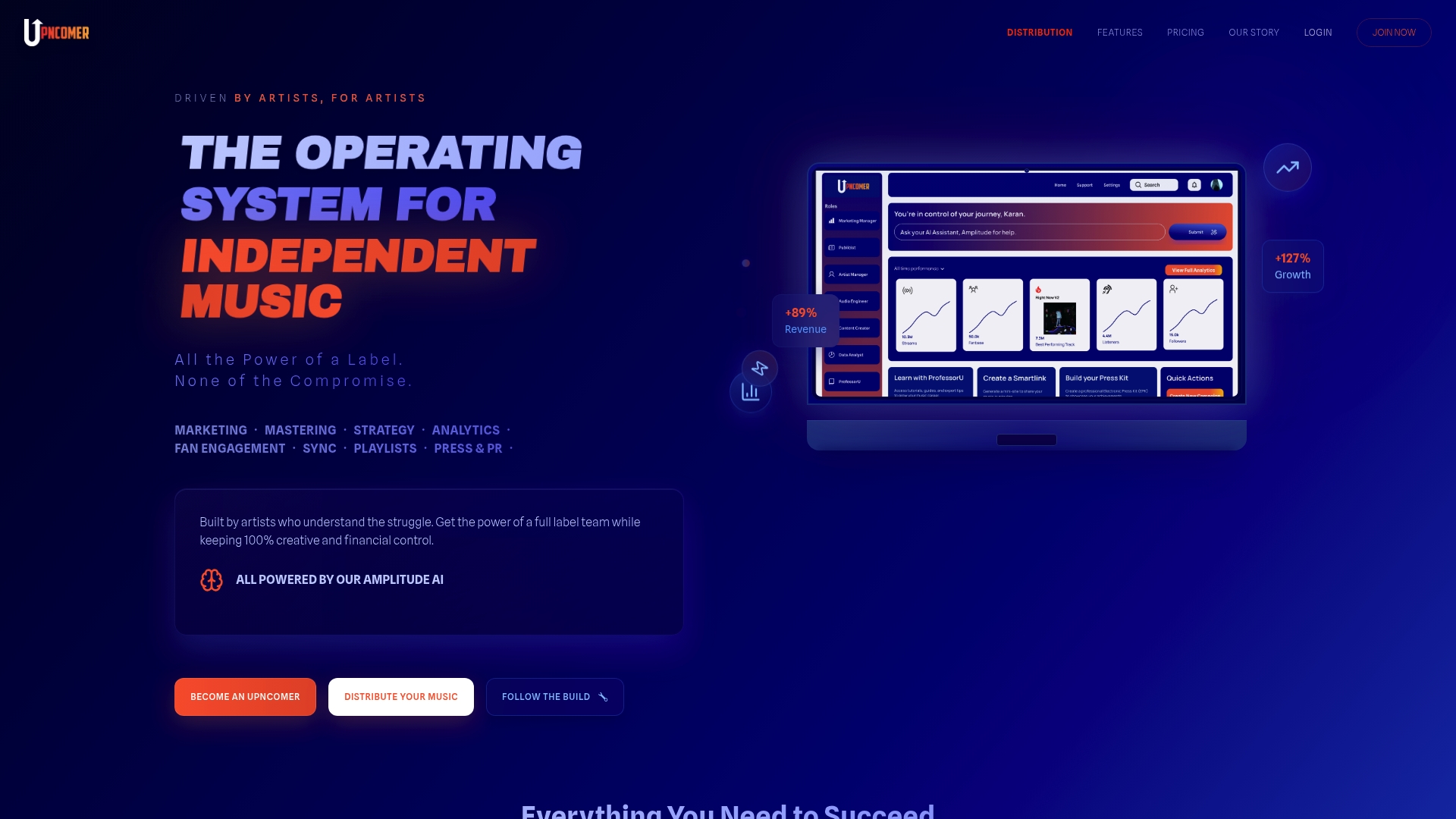
UpNComer’s platform connects Distribution (your release URLs and smart links), Growth Engine (campaign scheduling), Data Analyst (scan and streaming metrics), and Amplitude AI (pattern recognition and recommendations) into one workflow built for independent artists. You create the smart link inside the same platform where you distributed the track, track scans alongside streaming numbers, and get AI-driven recommendations on where to focus next.
No agency retainer. No manual data exports. No reprinting when a link breaks.
Start your QR campaign inside UpNComer and have your first smart-routing code ready before your next release drops.
Sources
The sources below are worth bookmarking for technical steps and legal context. QRSprint and Abundera cover smart-routing setup and device detection in detail. QRKit and iCheckQR are the clearest references for hosted-audio QR creation, supported formats, and dynamic code management. QR.io’s blog goes deeper on analytics configuration for printed music materials. Bandzoogle’s guide covers placement strategy and CTA best practices from an indie-artist perspective. For rights and distribution terms, go directly to your distributor’s help documentation and review Spotify’s developer and Spotify Codes pages for platform-specific rules.
- Music QR Code Generator, Any Platform · QRSprint
- Audio QR Code Generator | Create Free Audio QR Codes
- How to create QR code for audio from file, voice or music link · iCheckQR
- Free Audio QR Code Generator, MP3, Spotify, SoundCloud · Abundera
- Qr
- 5 best ways to share your music with QR codes · Bandzoogle Blog
FAQ
How do I get a QR code for my music?
Copy your streaming URL or upload your MP3 to a dynamic QR generator like QRKit or QRSprint, create a dynamic code, and test it on your phone before printing.
How do I convert a song to a QR code?
Upload your MP3 or WAV to a hosted-audio QR tool, or paste a public streaming link into a dynamic QR generator. The code then links directly to that audio file or stream.
Is it legal to put a QR code on a billboard or poster?
Generally yes, as long as you own or have rights to the content the code links to. Confirm your distribution agreement permits public sharing, and ensure the linked content is publicly accessible. Rules vary by territory, so check local advertising regulations for outdoor placements.
Is there a free scanner for Spotify QR codes?
Spotify’s own app includes a built-in scanner. Open the Search tab, tap the camera icon, and point it at any Spotify Code to open that content directly inside the app.
Can I update a QR code after it’s already printed?
Yes, if it’s a dynamic QR code. Dynamic codes point to an editable short URL, so you can change the destination from your dashboard without reprinting the physical material.