15 Minute Metadata Fix: Neighboring Rights Explained for Indie Artists
Neighboring rights are royalties paid to performers and recording owners whenever a sound recording gets played in public, separate from anything a songwriter collects. The framework traces back to the Rome Convention, and in the U.S., SoundExchange handles the collection. If you release music and haven’t registered your recordings with an ISRC on file, you’re almost certainly leaving royalties unclaimed right now.
TL;DR:
- Artists must register each recording with ISRC codes and performer credits beforehand to ensure accurate matching and to prevent royalties from being routed into the black box.
- Collecting societies in different countries rely heavily on reciprocal agreements, so registering with local societies and using an administrator can maximize international neighboring rights income.
- Payouts depend on territory-specific rules, with U.S. digital royalties following a statutory split between copyright owners and performers, while other regions often pay broader neighboring rights royalties for broadcast and public performance.
- Metadata accuracy, including performer credits and registration timing, is crucial; sloppy data can cause most royalties to be lost or delayed across the system.
- When disputes arise over neighboring rights payments, providing thorough documentation and locking in splits with a Letter of Direction helps resolve issues more efficiently.
Table of Contents
- What Are Neighboring Rights, Explained Simply?
- Who Gets Paid, and What the Splits Look Like
- How Collections Actually Work Behind the Scenes
- How to Collect Your Neighboring Rights Royalties
- Why Reciprocity Determines Whether You Get Paid Abroad
- Common Pitfalls and a 15-Minute Metadata Checklist
- Where Neighboring Rights Actually Came From
- How Neighboring Rights Laws Differ Across Major Territories
- Streaming and Digital Rights Management Changed the Collection Game
- Why Tracking Performance Data Matters More Than Most Artists Realize
- What Happens When a Royalty Payment Is Disputed
- Publisher Perspective: Treat Neighboring Rights as Part of Your Revenue Stack
- An Adjacent Route: Cleaner Metadata Means Fewer Lost Royalties
- Sources
- FAQ
What Are Neighboring Rights, Explained Simply?
Neighboring rights (also called related rights) cover the performance income owed to performers and master owners, not the songwriter. When a recording plays on satellite radio, a streaming service’s non-interactive channel, a bar’s sound system, or foreign terrestrial radio, that use can trigger a neighboring rights payment. The trigger and payout depend heavily on territory, since not every country treats every use the same way.
This is where confusion sets in for a lot of artists. You already know about performance royalties for the composition, the ones your performing rights organization collects when your song gets played. Neighboring rights are the recording-side twin of that system. If you wrote and recorded the song yourself, you’re entitled to both. If you recorded a cover, you only collect the neighboring rights share, since someone else owns the composition. The distinction matters because two completely different royalty pools open up from the same play.
Who Gets Paid, and What the Splits Look Like
Featured performers (the artist whose name is on the release) and non-featured performers (session musicians, background vocalists) both have a claim, alongside whoever owns the master, often you, if you self-release. In many territories, the collected pot splits roughly between performers and the master owner, though exact ratios vary by country. In the U.S., digital performance royalties follow a statutory formula, with the largest share flowing to the copyright owner and the remainder split between featured and non-featured performers, as Billboard’s breakdown of neighboring rights collection lays out. Session players get their non-featured share through a Letter of Direction filed with SoundExchange, so don’t skip that paperwork if you hired musicians.
How Collections Actually Work Behind the Scenes
Collective management organizations (CMOs) are the clearinghouses that make this whole system function. In the U.S., that’s SoundExchange. Elsewhere, it’s societies like PPL in the UK or GVL in Germany, which track and pay out neighboring rights within their own territories, as WIPO’s collective management overview confirms. These societies rely on reciprocal agreements to forward money across borders, meaning a play in Germany can eventually land in a U.S. artist’s SoundExchange account, but only if the paperwork lines up.
The matching key for all of it is your ISRC, the 12-character code stamped on every recording. Broadcasters and platforms report usage data using that code, and societies match it against their rightsholder databases to figure out who to pay, according to the US ISRC Agency.
A few mechanics worth knowing before you assume your check is coming:
- Payment cadence is usually quarterly, though timing varies by society and by how quickly usage data gets reported.
- Unmatched plays, meaning no ISRC or a mismatched performer credit, get shoved into what the industry calls the “black box.”
- Black box funds don’t sit around forever waiting for you. After a set period, unclaimed money often gets redistributed to other rightsholders in the pool.
How to Collect Your Neighboring Rights Royalties
Getting paid isn’t complicated, but it does require you to actually do the paperwork instead of assuming a distributor handles it for you. Most don’t.
- Register with SoundExchange first if you’re U.S.-based or U.S.-eligible. Opt into the international mandate while you’re at it, since it lets SoundExchange collect on your behalf from partner societies abroad.
- Decide your international collection route. You can affiliate directly with foreign societies, hire an administrator to manage multiple territories for a commission, or lean on SoundExchange’s reciprocal deals. Direct affiliation gets you a bigger cut but more paperwork; administrators cost more but save time and often recover older, unclaimed royalties you’d never find on your own.
- Gather your metadata before you register anything. You’ll need the ISRC for every recording, clear performer credits separating featured from non-featured, proof of residency or the relevant tax forms, and your banking details.
- Set expectations on timing and fees. Registration itself is usually free or low cost, but administrators typically take a commission off recovered royalties. Old claims can sometimes be pursued retroactively, so don’t assume a three-year-old release is a lost cause.
Pro Tip: Register even your smallest, oldest releases. Individually they might pay pennies, but stacked across a catalog and multiple territories, “too small to bother” money adds up faster than most independent artists expect.
Why Reciprocity Determines Whether You Get Paid Abroad
Reciprocity is the agreement between collecting societies that lets royalties cross borders. If your home society and a foreign society have a reciprocal deal, plays of your music abroad eventually route back to you. If they don’t, that money can get stuck or reallocated, since some societies won’t forward funds to countries that don’t extend the same courtesy to their own artists, per WIPO’s overview of CMO reciprocity.
The U.S. complicates this further. American law only recognizes neighboring rights for non-interactive digital transmissions, not traditional terrestrial radio. That’s a real gap. It means foreign societies sometimes withhold or limit payouts to U.S. artists for airplay in their territory, arguing the U.S. doesn’t reciprocate for radio. Legislative proposals like the American Music Fairness Act aim to close that gap, but until something passes, your best moves are registering directly with foreign societies, using an administrator with existing relationships, or leaning on SoundExchange’s international mandate to catch what you can.
Common Pitfalls and a 15-Minute Metadata Checklist
Most lost royalties trace back to sloppy metadata, not bad luck. Fix these five things and you’ll close most of the gap:
- Every track has a correctly embedded ISRC before release, not added after the fact.
- Performer credits list featured and non-featured contributors accurately.
- You’ve confirmed your distributor doesn’t automatically file neighboring rights claims (most don’t).
- You’ve registered with SoundExchange or your relevant society before release, not months later.
- You know your claim windows, since some societies cap how far back you can file.
Pro Tip: Run this checklist every single release, not just your first one. Fifteen minutes now beats months chasing unclaimed royalties later.
Where Neighboring Rights Actually Came From
The legal foundation dates to the Rome Convention of 1961, which obligated signatory countries to recognize performers’ and producers’ rights in sound recordings, separate from the older copyright protections that only covered composers and authors. Before that, a session musician or the label that funded a recording had no international legal claim over its public performance, no matter how many times it aired.
The Rome Convention set the baseline, but individual countries built their own systems on top of it. Some created statutory rates. Others left rates to negotiation between broadcasters and collecting societies. The World Intellectual Property Organization later expanded the framework through additional treaties addressing digital transmission, since the original convention obviously predated streaming by decades.
What’s worth understanding is that neighboring rights were never designed as an afterthought. They exist because performers and producers argued, successfully, that a recording is its own creative work deserving its own protection, distinct from the composition underneath it. That argument is why a session drummer on a hit record has a legal claim today that didn’t exist before 1961, and why the system still runs on treaty obligations rather than pure market convention.
How Neighboring Rights Laws Differ Across Major Territories
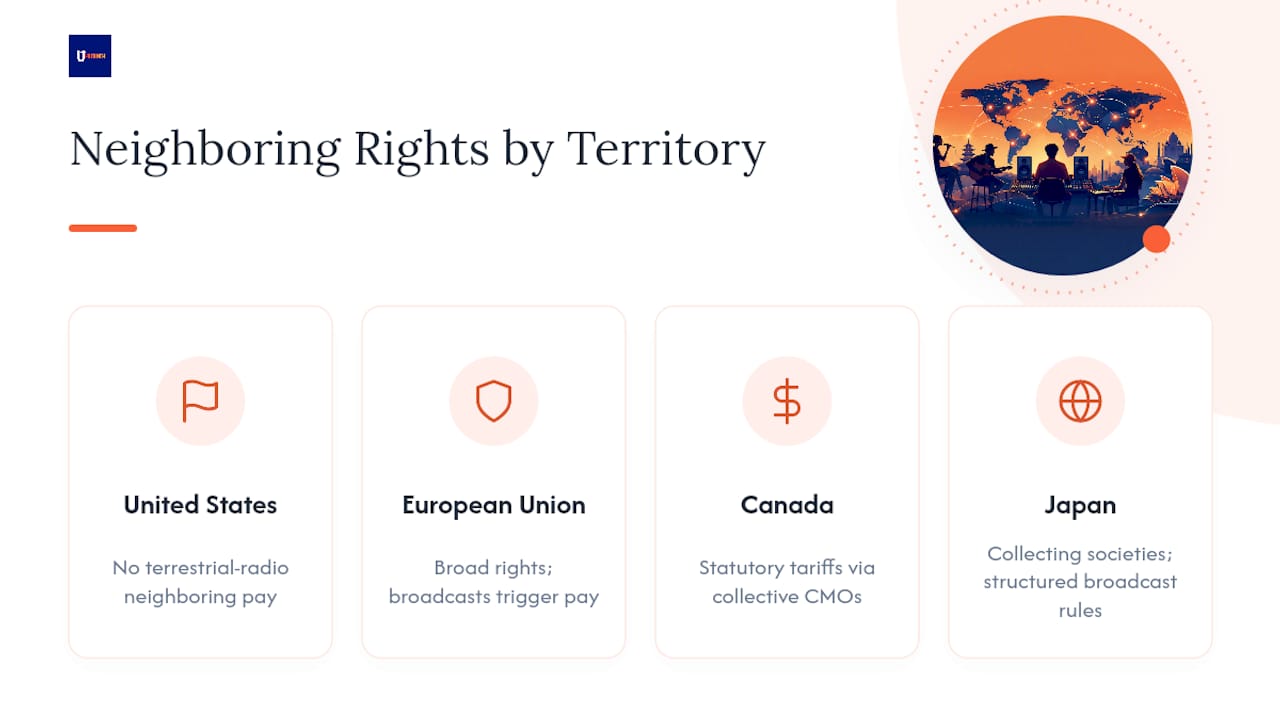
The Rome Convention set the floor, not the ceiling, and countries built very different systems on top of it. In the European Union, neighboring rights are broadly recognized and enforced through national CMOs like GVL in Germany, with EU directives pushing for harmonized minimum protections across member states. Broadcast and public performance uses generally trigger payment without the interactive/non-interactive distinction that trips up American artists.
Canada runs its own collective system with statutory tariffs set by its copyright board, covering commercial radio, satellite, and public performance venues, and it maintains reciprocal relationships that generally treat foreign performers fairly when reciprocal terms exist.
Japan’s system recognizes performer and producer rights through its own collecting societies, with structured statutory frameworks for broadcast use, though the practical mechanics of registration and international payout can differ enough from Western norms that artists working that market often lean on a specialized administrator rather than direct affiliation.
The throughline across all these territories: the U.S. is the outlier, not the norm. Most developed music markets pay neighboring rights on terrestrial radio without the carve-out that limits American law to non-interactive digital transmissions. That’s precisely why independent artists touring or getting airplay internationally need to think territory by territory rather than assuming one registration covers everything.
Streaming and Digital Rights Management Changed the Collection Game
Streaming didn’t just add a new revenue stream, it rebuilt the plumbing that background music rights for short video creators depend on. Every stream generates a usage report tied to metadata, and that metadata is now the entire basis for who gets paid. Compare that to old-school terrestrial radio, where usage logs were sometimes manual, delayed, or incomplete, and it’s easy to see why streaming data, done correctly, should theoretically make collection more accurate.
The catch is that “done correctly” depends entirely on whether your recording carries a clean ISRC and accurate performer credits at the point of upload. Digital rights management systems and platform-side matching tools are only as good as the data feeding them. A distributor that doesn’t push consistent metadata to platforms creates exactly the kind of mismatch that dumps your royalties into the black box.
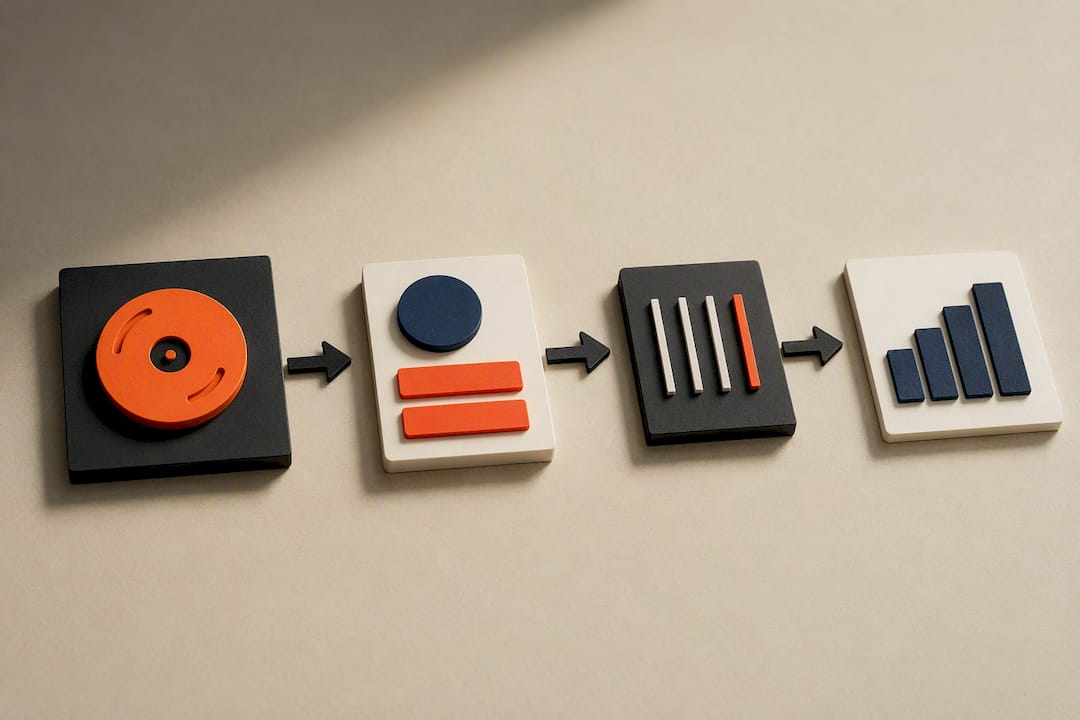
This is also where digital platforms have quietly shifted power toward artists who manage their own metadata carefully. Non-interactive digital transmissions, satellite radio, and certain streaming radio formats fall squarely under statutory neighboring rights obligations in the U.S., and the data trail for those uses is far cleaner than terrestrial airplay ever was. If you’re distributing through a platform that tracks ISRCs consistently and reports performer credits accurately from day one, you’re in a much stronger position to actually collect what streaming already owes you, rather than chasing it down after the fact.
Why Tracking Performance Data Matters More Than Most Artists Realize
Every royalty check traces back to a usage report, and usage reports are only as good as the tracking behind them. Broadcasters, streaming platforms, and venues generate logs of what played and when, then transmit that data to collecting societies, which match it against ISRC-tagged recordings in their databases.
The problem is that tracking isn’t uniform. A major festival with digital ticketing and setlist logging generates far cleaner performance data than a small venue running background music off a personal playlist. Streaming platforms report with near-perfect granularity because it’s baked into their infrastructure. Terrestrial radio and live venues often rely on spot-checks, sampling, or self-reported playlists that miss plays entirely.
That gap is exactly why artists who monitor their own streaming analytics and cross-reference it against what their CMO or SoundExchange actually reports catch discrepancies faster. If a track shows meaningful play counts on a platform but generates no corresponding royalty statement, that’s a signal worth chasing down, either a metadata mismatch or a reporting gap on the platform’s end. Tracking your own data isn’t just good practice, it’s often the only way to know money is missing at all before it disappears into a black box you’ll never see itemized.
What Happens When a Royalty Payment Is Disputed
Disputes over neighboring rights usually fall into one of three buckets: wrong payee (money went to the wrong performer or master owner), missing payment (a play happened but no royalty followed), or split disagreements (multiple performers or rightsholders can’t agree on allocation).
Most CMOs and SoundExchange have internal claims processes for the first two categories. You file a claim with documentation, ISRC, performer credit proof, release date, and the society investigates the usage report against its database. Resolution timelines vary by society, and backlash from disputing a payment is rare since these are largely administrative corrections, not adversarial claims.
Split disagreements are trickier because they usually involve multiple parties with competing interests, session musicians, featured artists, and sometimes labels. A Letter of Direction filed at the point of registration heads off most of these disputes before they start, since it locks in each contributor’s share upfront rather than leaving it to be negotiated after money is already sitting in an account. When disputes do escalate beyond a society’s internal process, they typically move to standard contract or copyright dispute channels, which is exactly why documenting performer agreements in writing before release matters more than most independent artists assume.
Publisher Perspective: Treat Neighboring Rights as Part of Your Revenue Stack
Neighboring rights aren’t a side quest, they’re a parallel income stream running alongside your streaming and publishing royalties, and treating them as an afterthought is how independent artists leave real money on the table. The fix isn’t complicated. It’s consolidation: clean metadata at distribution, consistent performer credits, and registration handled early rather than reactively. Artists who fold that discipline into their normal release workflow tend to reconcile royalties faster than those chasing missing payments years later.
— Karan
An Adjacent Route: Cleaner Metadata Means Fewer Lost Royalties
Registering with societies and administrators is still the actual mechanism for collecting neighboring rights, nothing replaces that step. But the reason so much money ends up in the black box traces back to messy metadata at the distribution stage, and that’s a problem you can solve before you ever file a claim.
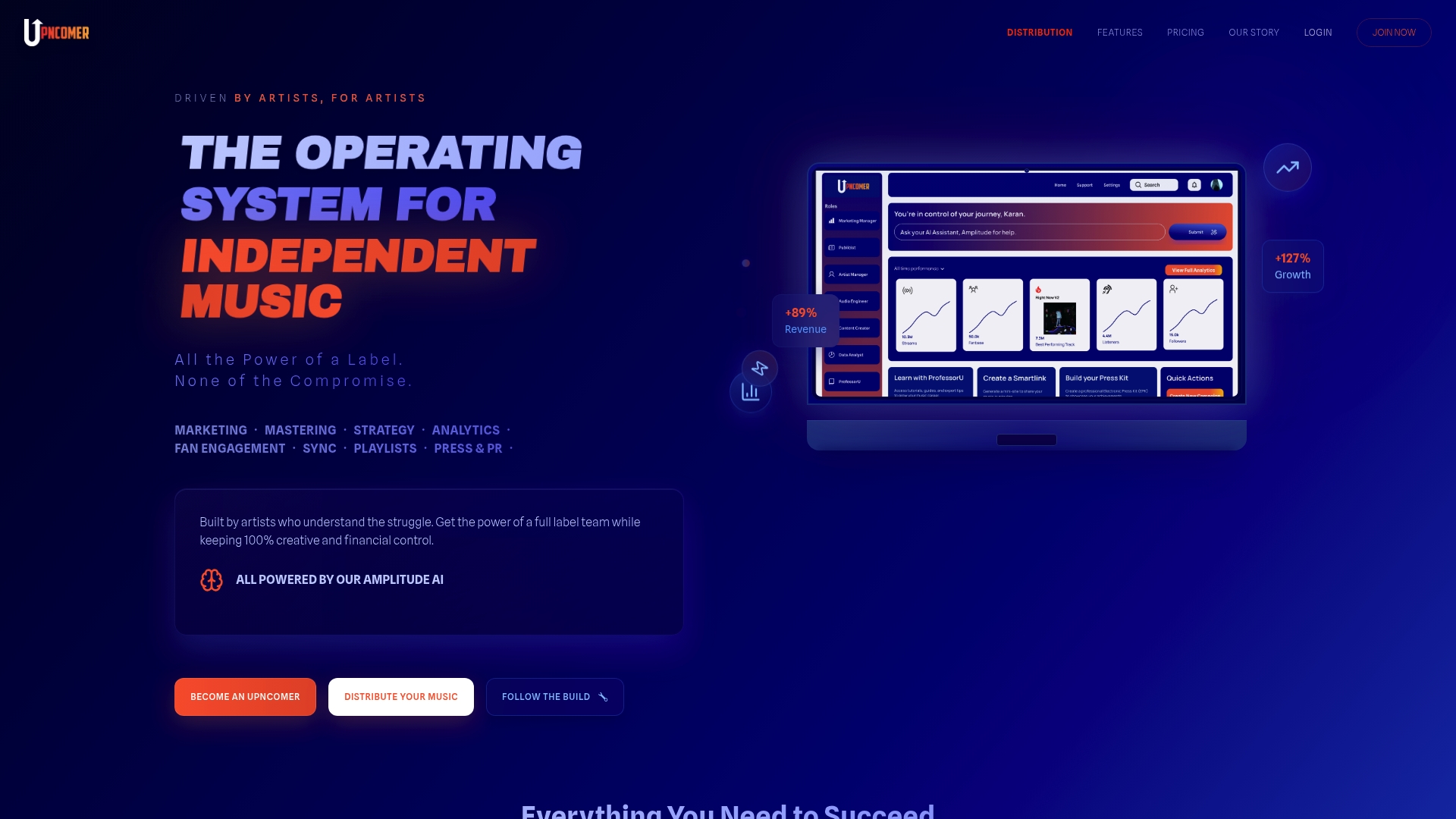
UpNComer’s Distribution module is built around keeping your ISRCs, performer credits, and release metadata consistent across every platform from day one, which is exactly the data that CMOs and SoundExchange rely on to match plays to payments. Pair that with the Data Analyst and Artist Manager tools inside the platform, and you get a clearer picture of where your recordings are actually getting played, so you can spot a reporting gap before it becomes years of unclaimed royalties. Distribution runs on a royalty split with no subscription fee, while the full toolkit, including Amplitude AI guidance and release planning, is part of UpNComer Pro, starting at $27 per month or $300 per year. If you’re about to release new music, get your metadata locked in through UpNComer before you register anywhere else.
Sources
Confirm treaty context through WIPO’s Rome Convention page, register U.S. digital royalties through SoundExchange, and review PPL and GVL for territory-specific collection rules.
- WIPO — Rome Convention
- Billboard (archived) — What Are Neighboring Rights and How Are They Collected
- U.S. Congress — Bill text (example of music-rights legislation)
FAQ
How Do I Get Paid From SoundExchange?
Register a free account on SoundExchange’s site, submit your ISRCs and performer credits, and opt into the international mandate to catch reciprocal foreign royalties too. Payments typically follow a quarterly cycle once your recordings are matched to usage reports.
Who Do Collecting Societies Actually Pay?
CMOs pay featured performers, non-featured performers, and master owners, the recording side of a play, not the songwriter. Composition royalties go through a separate performing rights organization entirely.
How Does a Society Know Who to Pay?
Societies match usage reports against their databases using the ISRC embedded in each recording, along with the performer credits you’ve registered. If either is missing or wrong, the play often lands in the unmatched black box instead of your account.
How Much Do Neighboring Rights Royalties Actually Pay?
Payouts vary widely by territory, usage type, and how many plays your recording generates, so there’s no fixed per-play rate to quote. What’s consistent is that U.S. digital performance royalties follow a statutory split between the copyright owner and performers, while other territories use their own negotiated or statutory rates.
Are Neighboring Rights the Same as Copyright?
No. Neighboring rights protect performers and recording owners specifically for the performance of the sound recording, while copyright in the composition belongs to the songwriter. Both can generate royalties from the same play, but they’re collected through entirely separate systems.