$300–$1,500 Music Ad Budgets by Career Stage for Indie Artists
Most independent artists should plan on $300 to $1,500 per release for paid promotion, with $100 as the practical floor for a small test. The rule that matters more than the number: set one clear goal, run the funnel math, spend a small slice on a 7 to 14 day test, then scale only what already works. Skip that order and even a $1,500 music ad budget gets burned on guesswork.
TL;DR:
- A realistic music ad budget includes creative production, tracking, platform fees, and a reserve, not just the ad spend on social platforms.
- Budgets should be guided by career stage, with emerging artists spending $100–$500 per release mainly for testing, and established artists investing up to $1,500 for full, multi-channel campaigns.
- Allocate part of the budget to testing creative and audience segments for 7 to 14 days before scaling, increasing spend gradually by 20 to 30 percent to avoid losing momentum.
- Different platforms serve different goals: Meta and TikTok are best for volume and discovery, while Spotify Ads and YouTube excel at high-intent, engaged audiences.
- Using an integrated platform for campaign management and analytics reduces wasted spending, speeds up testing, and links ad results directly to streaming outcomes.
Table of Contents
- What Does a Music Ad Budget Actually Pay For?
- How Much Should You Budget by Career Stage?
- How Do You Split a Music Ad Budget Between Testing and Scaling?
- Where Should You Spend: Meta, TikTok, Spotify, or YouTube?
- When Should You Spend and When Should You Scale Up?
- What Are the Biggest Music Ad Budget Mistakes?
- How Does an Integrated Platform Make Budgeting More Efficient?
- How Should Genre and Audience Change Your Budget?
- What Tools Help You Manage and Automate a Music Ad Budget?
- Author Perspective: Career-First Budgeting
- Get Your Campaigns and Budget in One Place
- Sources
- FAQ
What Does a Music Ad Budget Actually Pay For?
A lot of artists picture a music ad budget as just “money for the ads.” That’s the mistake. The number you see on Meta Ads Manager or TikTok is only one line item in a system that includes creative, tracking, and a reserve for when something breaks.
Here’s what a realistic budget actually covers:
- Paid media — the spend that buys impressions on Meta, TikTok, Spotify, or YouTube
- Creative production — the video edits, cover art, and short clips the ads actually run
- Landing pages and smart links — pre-save pages, bio links, and streaming links that turn a click into a saved song
- Tracking and analytics — pixel setup, UTM tagging, and dashboards that tell you what’s converting
- Platform and tool fees — scheduling, distribution, or campaign software
- A reserve fund — 10 to 15% held back for creative refreshes or an unexpected opportunity
Skip creative and tracking, and you’re not running a leaner campaign. You’re running a blind one, spending real money without any way to know why it worked or didn’t.
How Much Should You Budget by Career Stage?
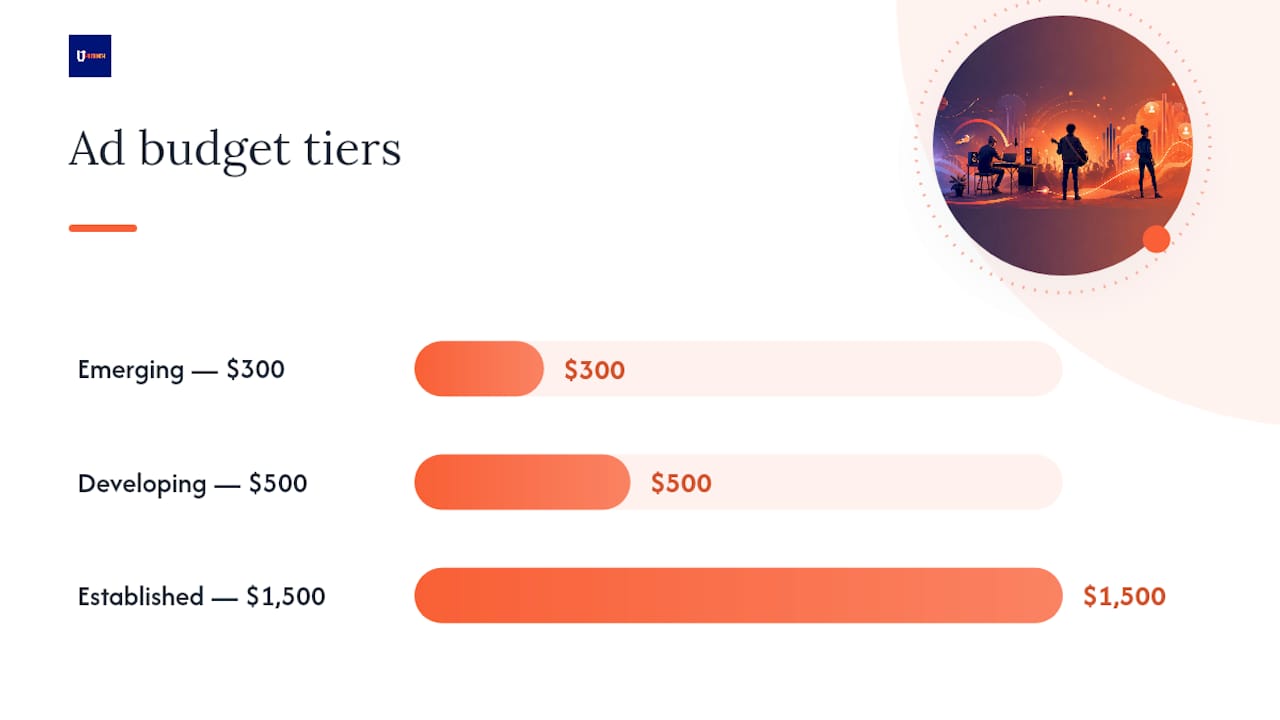
Your monthly listener count and release history should drive your music marketing budget more than any generic recommendation. A $300–$1,500 per release planning range covers most independent artists, but where you land inside that range depends on what stage you’re at.
Emerging artists (roughly under 5,000 monthly listeners) should treat every dollar as a learning tool. The goal isn’t streams. It’s finding out which creative and which audience actually respond. Organic growth and consistent release planning matter more here than ad spend.
Developing artists (5,000 to 50,000 monthly listeners) have enough data to retarget warm audiences and pitch playlists with confidence. This is where budgets start doing real work, because you’re no longer guessing who your fans are.
Established independent artists (50,000+ monthly listeners) can run multichannel campaigns across Meta, TikTok, and Spotify Ads simultaneously, layering in PR and creator partnerships.
| Career Stage | Monthly Listeners | Per-Release Budget | Primary Focus |
|---|---|---|---|
| Emerging | Under 5,000 | $100–$500 | Creative testing, organic growth |
| Developing | 5,000–50,000 | $400–$500 | Retargeting, playlist pitching |
| Established | 50,000+ | $1,000–$1,500 | Multichannel scaling, PR |
If you’re brand new with no released music and no baseline data, paid ads are premature. Spend that money on a few organic posts and a proper pre-save setup first. You’ll waste less and learn faster.
How Do You Split a Music Ad Budget Between Testing and Scaling?
This is the single most skipped step in budgeting for music promotion, and it’s why so many campaigns feel random.
Here’s the actual test-to-scale process:
- Set the test window. Run 3 to 6 creative variations across two audience sets over 7 to 14 days. Don’t judge results before day 5. Early data lies.
- Watch delivery and conversion stability, not just raw numbers. A cheap cost-per-click on an audience that never saves the song is not a signal worth scaling.
- Kill what’s flat. If a creative shows no meaningful engagement after the full test window, cut it. Don’t keep it alive out of attachment.
- Scale the winner in steps. Increase spend by 20 to 30% at a time rather than doubling overnight, so you can catch a drop in performance before it burns your whole reserve.
Three sample allocations you can copy directly:
$300 budget (emerging artist, single track):
- Prospecting: $150
- Retargeting: $60
- Creative: $50
- Playlist pitching: $30
- Reserve: $10
$500 budget (developing artist, EP or single push): based on a documented MelodicMind sample split, Spotify pitching $150, TikTok creators $200, Meta retargeting $100, pre-save page $20, reserve $30.
$1,500 budget (established artist, full release cycle):
- Prospecting across Meta and TikTok: $600
- Retargeting: $450
- Creative production: $250
- Playlist pitching and PR: $150
- Reserve: $50
A steady-state guideline worth adopting long term: allocate 10 to 20% of your monthly music income to marketing, scaling higher during active growth windows.
Where Should You Spend: Meta, TikTok, Spotify, or YouTube?
Each platform earns its budget differently, and treating them as interchangeable is where most music ad spending strategies fall apart.
- Meta (Facebook and Instagram) delivers volume at a lower cost per result, making it the strongest top-of-funnel driver for reaching new listeners cheaply.
- TikTok rewards native, low-production creative that doesn’t look like an ad; it’s built for discovery, not direct conversion.
- Spotify Ads costs more per impression but wins on intent, since you’re reaching people already inside a listening app.
- YouTube works best for video-driven campaigns, official videos, and building watch-time habits with fans who prefer longer content.
What raises your CPM or cost-per-result across all four: a narrow audience tier, a premium ad format like Reels or Stories, seasonal demand spikes around holidays, and creative that feels generic rather than native to the platform.
Default 2026 CPM ranges run TikTok $6–$10, Meta $10–$18, Spotify Ads $15–$25, and YouTube $9–$15. These are planner defaults, not guarantees. Your own account data should replace them fast.
If your goal is raw stream volume, weight your advertising costs for musicians toward Meta and TikTok. If your goal is engaged, high-intent listeners who save and follow, Spotify Ads earns a bigger slice despite the higher CPM. Meta often produces a lower cost per stream as a volume driver, while Spotify’s in-app placement converts better on intent, even at a steeper price.
When Should You Spend and When Should You Scale Up?
Timing determines whether a good creative ever gets the chance to prove itself. Spread spend across a release cycle instead of dumping it all on release day.
- 8 weeks out — Finalize creative, set up pixels and tracking, and launch a small test batch on the reserved test slice of your budget.
- 4 weeks out — Review early signals. Kill weak creative, double down on whatever’s showing strong saves or watch time.
- 2 weeks out — Push retargeting to warm audiences who’ve engaged but haven’t converted yet. Start playlist pitching if you haven’t already.
- Release week — Shift budget toward conversion. This is when cost-per-result finally reflects real listener behavior, not early curiosity.
- Weeks 2 to 4 post-release — Scale the top performer in 20 to 30% increments, watching cost per result and follower growth as your gate.
Watch click-through rate, save rate, watch time, follower growth, and cost per result at every checkpoint. If cost per result holds steady or drops while you increase spend, that’s your green light to scale. If it climbs sharply, pause before you pour more into a fading creative.
Pro Tip: Doubling your daily budget overnight resets the ad platform’s learning phase, which often makes your cost per result spike temporarily. Small, steady increases protect the momentum you’ve already built.
What Are the Biggest Music Ad Budget Mistakes?
Most wasted ad dollars trace back to a handful of repeat offenders, and every one of them is avoidable with a five-minute check before you hit publish.
- Paying for streams. Pay-for-stream services and follower farms are explicitly flagged by marketing guides as wasteful or risky, and platforms increasingly detect and penalize fake engagement.
- Boosting an untracked post. The blue “Boost” button on Meta feels easy, but it skips the pixel setup and audience targeting that Ads Manager gives you for the same money.
- Skipping creative testing entirely. One creative, one audience, no comparison. You’ll never know what actually worked.
- Missing pixel or attribution setup. Without tracking, you can’t tell a great campaign from a lucky one.
- No stop rule. Decide your kill criteria before launch, not after you’ve already spent the reserve trying to save a flat campaign.
If your budget is genuinely tight, skip expensive PR retainers and lean on playlist pitching and organic content instead. They cost time, not dollars, and they build the same kind of momentum a press release rarely delivers for an unknown artist.
How Does an Integrated Platform Make Budgeting More Efficient?
Running ads, checking analytics, building smart links, and pitching playlists across five separate tools eats time you could spend testing creative. An integrated platform removes that friction by putting campaign management, audience data, and reporting in one place.
Here’s where that actually saves you money, not just time:
- Campaign orchestration — launching and adjusting ads without re-entering the same audience data across platforms
- Audience temperature tracking — knowing whose cold, warm, or ready to convert without manually cross-referencing spreadsheets
- Faster reporting — seeing cost per result the same day instead of piecing it together across four ad accounts
Inside UpNComer, Amplitude AI reads your campaign and streaming data together, which shortens the test-to-scale loop described earlier. Growth Engine handles the campaign orchestration piece, while smart links and Data Analyst dashboards keep audience temperature visible in one screen instead of six tabs.
Pro Tip: The fastest way to waste a small budget is switching tools mid-test. Keep your tracking consistent for the full test window, even if the early numbers look unimpressive.
How Should Genre and Audience Change Your Budget?
Genre changes where your fans already are, which changes where your budget should go. A hip-hop or pop artist with a highly visual brand often gets more mileage from TikTok, where native short-form content spreads fast among younger, discovery-driven audiences. A folk or singer-songwriter act frequently sees stronger results on Meta and YouTube, where longer attention spans and an older audience skew reward narrative-driven video and steady retargeting.
Electronic and dance artists tend to build loyal niche communities on Spotify and through curator playlist pitching, since intent-driven listening matters more than viral reach for that audience. Metal and heavier genres often see disproportionate engagement from small, highly active Meta and YouTube communities where a modest budget stretched over consistent creative outperforms a broad TikTok push.
Your target audience’s age and platform habits matter as much as genre. A younger fan base under 25 skews toward TikTok and Instagram Reels, so weight creative production dollars toward vertical video. An older or more niche fan base often responds better to Spotify Ads and YouTube, where a slightly higher CPM buys more qualified attention.
The practical move: pull up your existing streaming analytics before you set next release’s ad budget. If your listener base already skews toward one platform, that’s where your test slice belongs first, not wherever conventional wisdom says spend should default.
What Tools Help You Manage and Automate a Music Ad Budget?
Running a music ad budget by memory, across five browser tabs, is how good campaigns quietly bleed money. A dedicated toolset for campaign management, analytics, and creative production closes that gap.
At minimum, look for tools covering three jobs: campaign management (launching and adjusting ads without manual re-entry), analytics (streaming and ad performance in one dashboard), and creative production (fast content turnaround for testing multiple variations). Standalone tools exist for each, but stitching them together costs setup time you could spend on actual testing.
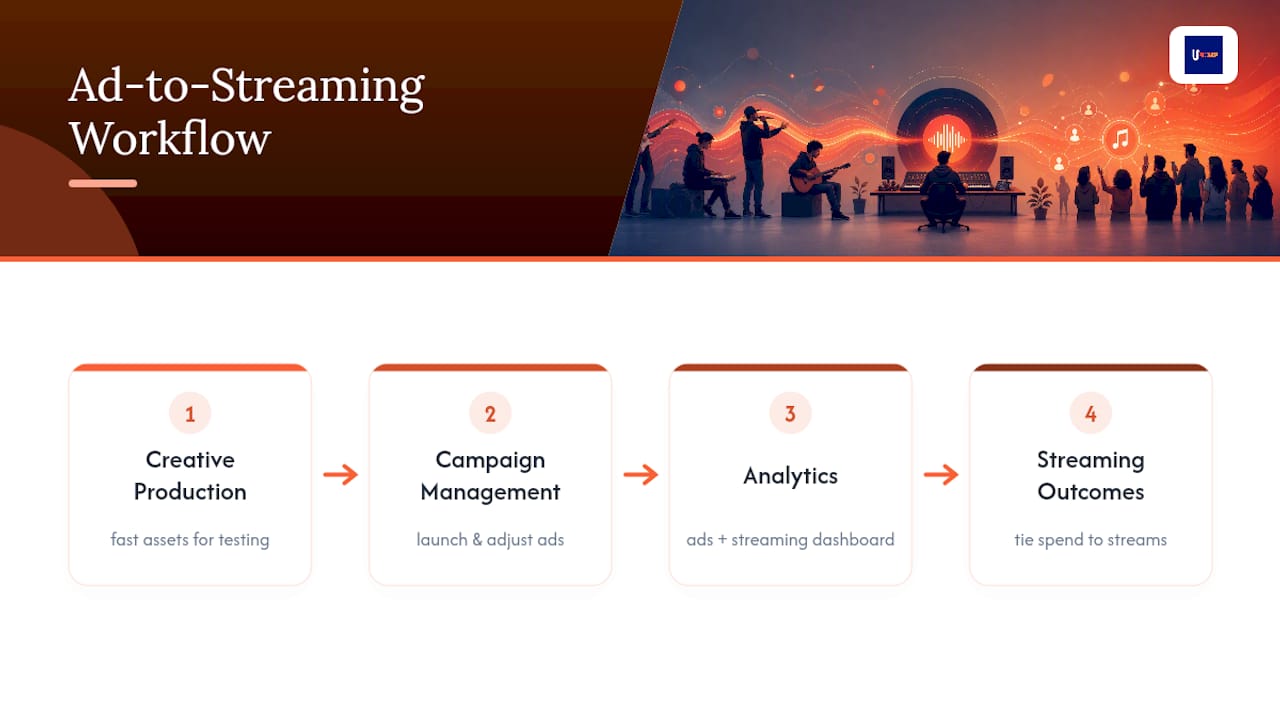
UpNComer consolidates these functions: Growth Engine for campaign management and ad orchestration, Data Analyst for streaming and audience analytics, UrStudio for mixing and mastering, Content Creator for fast-turnaround creative assets, and Distribution for getting the release live in the first place. ProfessorU rounds it out with education for artists still learning the funnel math behind their first few campaigns.
Whatever platform you choose, prioritize one that connects your ad spend directly to streaming outcomes. A tool that shows ad performance in isolation from your Spotify or Apple Music numbers leaves you guessing at the exact connection this whole budgeting process is built to reveal.
Author Perspective: Career-First Budgeting
The biggest mistake in music ad spending strategies isn’t overspending or underspending. It’s treating a single release like a lottery ticket instead of one data point in a longer pattern. A $1,500 budget spent once teaches you less than $300 spent four times with real testing in between.
Think of your ad budget as artist financial planning, not a release expense. Each campaign should make the next one smarter.
— Karan
Get Your Campaigns and Budget in One Place
UpNComer replaces the five-tab juggling act of separate ad platforms, spreadsheets, and analytics dashboards with one system built specifically for independent artists managing their own campaigns. Instead of exporting data from Meta, cross-checking it against Spotify for Artists, and guessing at your real cost per result, Growth Engine and Data Analyst keep your campaign spend and streaming outcomes in the same view.
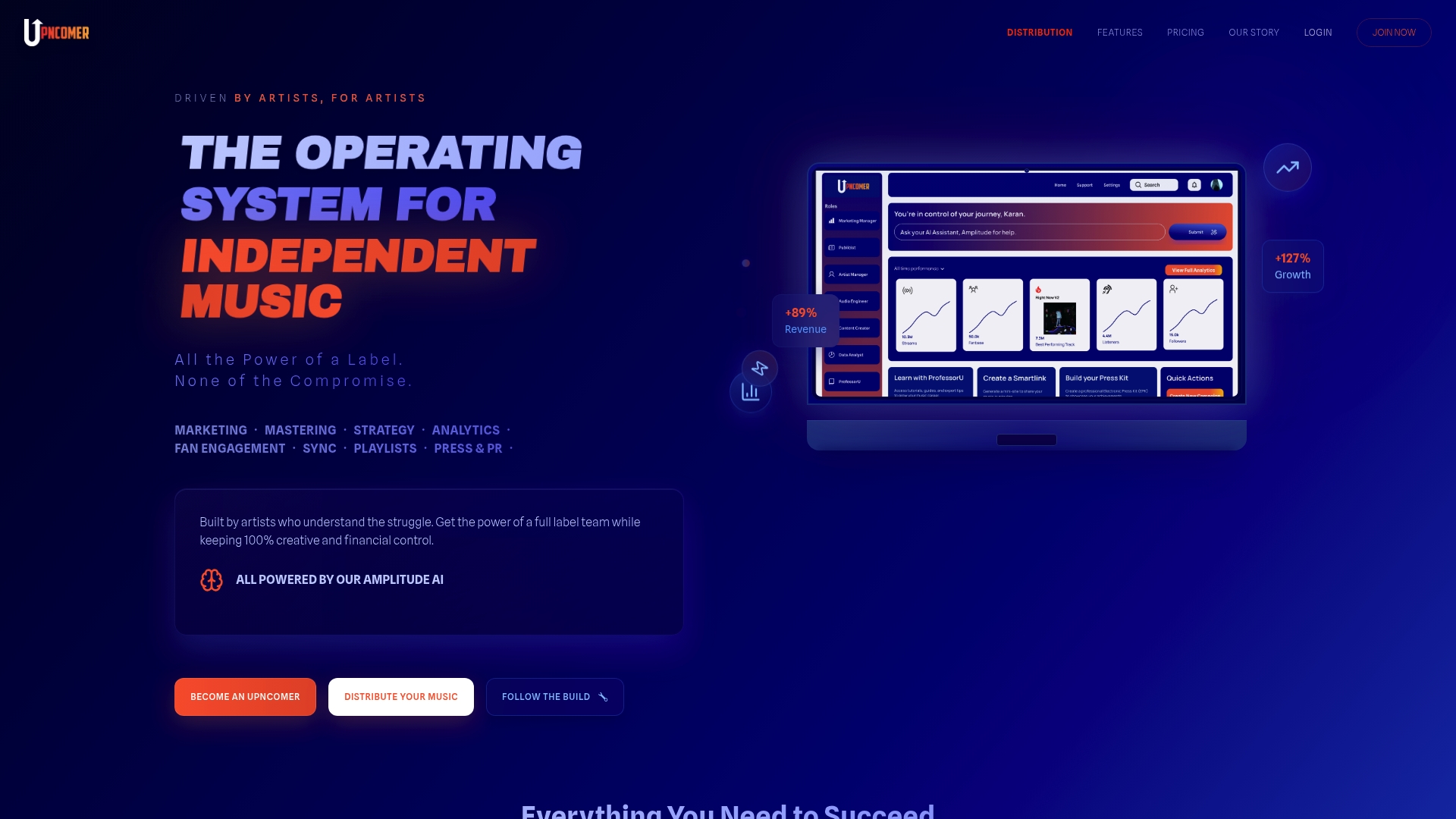
Amplitude AI reads your test data as it comes in, helping you spot which creative and audience combination is actually working before you commit your scaling budget to it. Smart links from the platform connect your ad clicks straight to streaming and pre-save actions, so the funnel math from this guide runs on your real numbers instead of planner defaults.
UpNComer Pro runs $27 per month or $300 per year, covering the full toolset from campaign management to mastering. If you’re pairing your next ad push with a release, the Music Distribution product runs on a 6% royalty split with no subscription fee, so your ad budget and your streaming revenue live under the same roof. Head to the pricing page to see the plans and start your next campaign with actual data behind it.
Sources
For your own numbers, the De Novo Agency budget calculator and the Tools4Music ad planner are solid starting points for funnel math and CPM defaults. Both rely on editable assumptions, not fixed rules, so swap in your own ad-account data as soon as you have a full test cycle behind you.
- Music Ad Planner | Compare TikTok, Meta, Spotify & YouTube Ad Costs | Tools 4 Music 2026
- Indie Music Marketing Budget Allocation, $500 in 2026 | MelodicMind
FAQ
How Much Does Spotify Pay Per Million Streams?
Spotify’s per-stream rate varies by market and subscription mix, but it typically works out to a few thousand dollars per million streams rather than a fixed rate. That’s why most music ad spending strategies focus on cost per result and audience building rather than treating streams as direct revenue.
How Much Does a 30-Second Radio Ad Cost?
Radio ad costs vary widely by market size and station, often running from a few hundred to several thousand dollars for a single 30-second spot. For most independent artists, that cost sits well above a typical per-release music ad budget, which is why digital platforms remain the more cost-effective music marketing route.
What Is the 70-20-10 Rule for Marketing Budget?
Applied to music ad spending, that means most of your budget should go to a creative and audience combination you’ve already tested, with a smaller slice reserved for trying something new.
Is $20 a Day Good for Google Ads or Music Ads?
$20 a day works as a modest test budget, roughly covering a week or two of testing, which lines up with the lower end of a practical $100–$500 entry range for indie artists. It won’t sustain a full multichannel push, but it’s enough to compare a few creative variations before committing more.
How Much Should I Budget for a Music Ad Campaign?
Most independent artists should plan for $300 to $1,500 per release, adjusted by career stage and goals, following the De Novo Agency planning range.