Splitting Music Royalties: A Practical Guide for Artists
Agree your publishing and master splits in the studio, sign a split sheet before anyone leaves, and register those percentages with your PRO and distributor before release. That single sequence prevents the vast majority of payment disputes and frozen royalties independent artists face.
Do this before you release:
- Decide who contributed what and assign percentages (publishing and master separately).
- Fill out a split sheet with legal names, PRO affiliations, IPI numbers, and signatures
- Register the composition with ASCAP, BMI, or SESAC (each writer registers their own share)
- Register mechanical rights with The Mechanical Licensing Collective (The MLC)
- Upload matching split metadata to your distributor
- Document any producer points or upfront fees in a separate producer agreement
Sign the split sheet before you release. Not after. Before.
Key Takeaways
Splitting royalties correctly means documenting agreements before release, registering with the right organizations, and keeping all three systems (PRO, MLC, distributor) in sync.
| Point | Details |
|---|---|
| Sign before release | A signed split sheet with legal names, IPI numbers, and PRO affiliations is your primary protection against payment disputes. |
| Publishing and master are separate | Publishing splits (PRO, MLC) and master splits (distributor, producer points) are two distinct pools with different registration paths. |
| Producer points scale with experience | Typical ranges run from 2–3 points for new producers to 10+ for top-tier, each earning that percentage of master income. |
| Mismatched registrations freeze payments | PROs hold payments when registrations conflict; match your split sheet, PRO data, MLC data, and distributor metadata exactly. |
| UpNComer syncs your split metadata | UpNComer’s Distribution and Artist Manager modules keep split data aligned across platforms, reducing collection errors for independent artists. |
Table of Contents
- How do splits turn into real dollars? Quick scenarios
- What’s the difference between publishing and master royalties?
- What split approach actually works for your situation?
- What does one producer “point” actually pay you?
- What do you actually need to sign and where do you register?
- Can you change splits after a song is already out?
- What can split automation tools actually do for you?
- Your ready-to-use checklist and where to find templates
- How does royalty income get taxed for each party?
- How do advances and recoupment affect your royalty splits?
- How are mechanical royalties split and paid?
- What role do music supervisors and sync licenses play in splits?
- The split conversation most artists avoid having
- UpNComer keeps your splits organized so you can focus on the music
- Sources
- FAQ
How do splits turn into real dollars? Quick scenarios
Splits are abstract until you see them on a $10,000 royalty statement. Publishing and master royalties come from two separate pools, so the math runs twice.
Four common scenarios:
- Two co-writers, 50/50: Each writer earns $5,000 from a $10,000 publishing pool.
- Writer plus producer, proportional: Writer holds 70% of publishing ($7,000); producer holds 30% of master points on a separate $10,000 master pool ($3,000).
- Producer at 4 master points: On $10,000 in master income, 4 points = $400 to the producer.
- Featured artist at 15% of master: On $10,000 master income, featured artist earns $1,500; remaining $8,500 goes to the primary artist or label.
One critical detail: publishing and master are always separate pools. A producer who earns points on the master gets nothing from the publishing pool unless they also wrote the song. Keep those two buckets distinct in every conversation and every document.
What’s the difference between publishing and master royalties?
This is the split that trips up most independent artists, and getting it wrong means money goes to the wrong person or sits uncollected.
Publishing (composition) covers the song itself: the lyrics, melody, and arrangement. Every time the song is streamed, broadcast, or covered, the composition generates royalties. These split into a writer’s share and a publisher’s share. The writer’s share goes directly to the songwriter through their PRO and cannot be signed away. The publisher’s share goes to whoever administers the publishing, which for self-published artists is themselves.

Master (sound recording) covers the specific recording. Whoever owns the master, typically the artist or label, earns income from streaming, sync licenses, and digital performance. Producers and featured artists negotiate their cut from this pool, not from publishing.
Here’s who collects what in the U.S.:
- Performance royalties (composition): ASCAP, BMI, or SESAC collect and pay the writer’s share directly to songwriters; publisher’s share goes to the publisher.
- Mechanical royalties (composition): The MLC collects and distributes mechanicals for on-demand streams in the U.S.
- Master income: Your distributor collects streaming revenue and pays it to whoever owns the master, per the split metadata you uploaded.
- Sync licenses: Negotiated directly or through a music supervisor; both a sync fee (master) and a publishing license fee (composition) apply.
Registration path in plain terms: register your song with your PRO as a writer, register the publishing share (your own if self-published), submit mechanical data to The MLC or through a publishing admin, and upload split metadata to your distributor. All three registrations need to match.
What split approach actually works for your situation?
There’s no universal right answer, but there are clear patterns for when each method makes sense.
Equal splits
Many rooms default to 50/50 or equal shares among all contributors, and there’s a real logic to it. Equal splits prevent the awkward post-session argument about who wrote the hook versus who suggested the chord change. They’re especially common in pop, hip-hop, and EDM sessions where multiple people contribute quickly and tracking individual contributions gets messy fast. Industry observers note that equal splits often hold up better long-term because no one feels shortchanged.
Proportional splits
Proportional splits assign percentages based on actual contribution: who wrote the lyrics, who built the beat, who wrote the melody. This approach rewards contribution accurately but requires an honest conversation in the room, ideally before the session ends.
Upfront fee vs. points vs. a mix
Producer payment structures fall into three categories:
- Work-for-hire (upfront fee only): Producer gets paid once and retains no ongoing royalty interest. Good for producers who need cash now; good for artists who want clean ownership.
- Points only (backend): Producer takes no upfront fee but earns master points. Higher risk for the producer, higher upside if the song performs.
- Fee plus points: The most common professional arrangement. Producer gets a smaller upfront fee and a reduced points share, balancing immediate income with long-term upside.
Practical negotiation phrasing:
- Asking for points: “I’d like to take a smaller fee and hold 3 points on the master. Can we document that today?”
- Offering a fee instead: “I can do a flat $500 buyout, or $200 plus 2 points. Which works better for you?”
Pro Tip: Default to equal splits when you’re in a fast creative session with people you trust. Save the proportional negotiation for situations where one person’s contribution is clearly dominant, like a producer who built the entire beat before the session started.
What does one producer “point” actually pay you?
One point equals one percentage point of master royalty income.
Producer point ranges scale with experience and credits:
Featured artists typically earn 10–25% of master royalties, depending on bargaining power and how much they contributed creatively.
Understanding how those points translate to streaming revenue is where music production analytics becomes genuinely useful. Knowing your per-stream rate and total stream count lets you project what a given points deal is actually worth before you sign it.

What do you actually need to sign and where do you register?
This is the paperwork section. It’s not glamorous, but it’s what separates artists who get paid from artists who spend years chasing money.
Split sheet essentials
A valid split sheet needs every one of these fields. Missing even one can cause registration problems later. Mismatched or incomplete registrations cause PROs to freeze payments until the conflict is resolved.
- Legal name of each contributor (not stage names)
- PRO affiliation (ASCAP, BMI, or SESAC)
- IPI/CAE number for each writer
- Publisher name and IPI (or “self-published” if applicable)
- Percentage of publishing each writer holds (must total 100%)
- Song title, ISRC if available
- Date and signatures from all parties
Producer agreement essentials
A producer agreement covers the master side. It should include:
- Producer’s points percentage and the basis (net or gross master income)
- Any upfront fee and payment schedule
- Recoupment terms (does the fee recoup against points?)
- Delivery requirements (stems, session files, mix approval)
- Credit language (how the producer is credited on release)
- Reversion clause if the song is never released
Step-by-step registration checklist
- Each writer registers the song with their own PRO (ASCAP, BMI, or SESAC) using the agreed percentages.
- ASCAP’s Splitsville provides co-writer registration tools and guidance for documenting splits correctly.
- Register the publishing share with The MLC (or through a publishing admin service) for U.S. mechanical royalties.
- Upload split metadata to your distributor, matching the exact percentages on the split sheet.
- Confirm that PRO registrations, MLC data, and distributor metadata all show the same numbers.
- Store signed copies digitally, with each party holding their own copy.
Do all of this before the release date. Retroactive registrations are possible but slow, and income generated before registration may be difficult or impossible to recover.
Pro Tip: Designate one person in the collaboration to be the “PRO submitter.” That person confirms everyone else has registered their share and flags any discrepancies before release. One point of accountability prevents a lot of confusion.
Can you change splits after a song is already out?
Yes, but it’s harder than you think, and it takes longer than you want.
Changing splits after release requires unanimous consent from all parties. One person can’t unilaterally update their percentage. Once everyone agrees, you need to update the registration at your PRO, submit corrected data to The MLC, and push updated metadata through your distributor. Each of those organizations processes changes on its own timeline, and none of them are fast.
Common friction points:
- PROs place a “conflict hold” on payments when two registrations don’t match. Money sits in a holding account until the conflict is resolved.
- Distributors may freeze metadata updates on songs that are actively generating income.
- The MLC processes mechanical registration updates, but there’s a lag before corrected data affects payments.
- If no signed split sheet exists, proving the original agreement becomes much harder. A signed document is your strongest evidence in any dispute.
Dispute resolution steps, in order:
- Pull out the signed split sheet. If everyone signed it, that’s your starting point.
- Attempt direct negotiation between parties. Most split disputes are about miscommunication, not bad faith.
- If direct negotiation fails, propose mediation through a music industry mediator before involving attorneys.
- If mediation fails, a music attorney can send formal correspondence or pursue arbitration.
- As a last resort, litigation. This is expensive and slow; avoid it by signing the split sheet before release.
Timeline reality: a straightforward PRO registration correction can take 60–90 days to show up in payments. A contested dispute with a conflict hold can take much longer. The signed split sheet you complete in five minutes today can save you months of that process.
What can split automation tools actually do for you?
Distribution platforms and split tools can automate a lot of the payment logistics. Auto-split features typically include automatic payouts to collaborators’ bank accounts or PayPal, recipient caps (a maximum payout per collaborator), recoup thresholds (the tool withholds payments until a fee is recouped), and downloadable payment reports.
Before you rely on any split tool, verify these settings:
- PRO and IPI fields are correctly mapped for each collaborator
- Publisher fields match what’s registered with the PRO and The MLC
- Recipient cap behavior is documented and agreed upon by all parties
- Recoup rules are explicit: what recouped, at what rate, and who decides when it’s cleared
- The tool exports an audit trail you can share with collaborators
The critical warning: auto-splits on distribution handle master income only. They do nothing for publishing royalties, which flow through PROs and The MLC on entirely separate systems. If your PRO registration doesn’t match your distributor split, you’ll receive master income correctly but publishing royalties will either go to the wrong party or sit uncollected. Automation needs a metadata reconciliation step, not just a bank account number.
UpNComer’s Distribution module is built to keep split metadata synchronized, reducing the mismatch errors that cause collection problems downstream.
Your ready-to-use checklist and where to find templates
Use this checklist for every collaboration, every time.
Before the session:
- Discuss split expectations with all collaborators
- Agree on fee vs. points structure for any producer involved
- Have a blank split sheet ready (digital or printed)
In the session:
- Finalize percentages before anyone leaves
- Complete all split sheet fields (legal names, PRO, IPI, percentages)
- Get signatures from every contributor
After the session, before release:
- Each writer registers with their PRO
- Submit to The MLC for mechanical rights
- Upload matching metadata to your distributor
- Confirm all three registrations match
- Store signed copies in a shared folder accessible to all parties
For templates:
- Songkeeper’s free split sheet template includes an interactive calculator to assign percentages and catch math errors before you register. Required fields include legal names, IPI/CAE numbers, PRO affiliation, and a designated PRO submitter.
- Songtrust’s downloadable split sheet is a clean, signable template that emphasizes the importance of completing all fields before distribution.
- For digital signatures, tools like DocuSign or HelloSign create a timestamped audit trail. Each party should hold their own signed copy; one designated person should keep the master file.
How does royalty income get taxed for each party?
Royalty income is ordinary income in the United States. Whether you’re a songwriter, producer, or featured artist, the IRS treats royalties as self-employment income if you’re operating as an independent contractor or sole proprietor, which most independent artists are.
If you expect to owe more than $1,000 in taxes for the year, the IRS requires quarterly estimated payments. Missing those payments triggers penalties.
A few practical points:
- Keep every split sheet and producer agreement as a business record. These documents establish what percentage of income belongs to you, which matters if you’re ever audited.
- If you receive a 1099-MISC or 1099-NEC from a distributor or PRO, that income is reportable even if you didn’t receive a form.
- Forming an LLC or S-Corp can reduce self-employment tax exposure at higher income levels, but consult a tax professional before making that move.
- International royalties may be subject to withholding taxes in the country of origin. PROs and distributors often handle this automatically, but you should confirm the withholding rate and whether a tax treaty applies.
This is general information, not tax advice. Confirm your specific situation with a qualified tax professional.
How do advances and recoupment affect your royalty splits?
An advance is money paid upfront against future royalties. It doesn’t change your split percentage, but it does change when you start seeing money. Until the advance recoups, royalties that would otherwise flow to you are retained by whoever paid the advance.
Producer advances work similarly. On a song generating $500 per month in master royalties, that’s roughly 10 months before the producer sees backend income.
Recoupment basis matters enormously. “Recouped from your share” (net) is very different from “recouped from total revenue” (gross). Always specify the basis in the producer agreement. Artist financial planning that accounts for recoupment timelines helps you budget realistically rather than counting on royalty income that’s still locked behind an advance.
How are mechanical royalties split and paid?
Mechanical royalties are generated when a song is reproduced, specifically when it’s streamed on demand or downloaded. In the U.S., The MLC collects and distributes these royalties for streaming services under the Music Modernization Act.
The mechanical royalty belongs to the composition, not the master. So the split follows your publishing percentages, not your master deal.
How the money flows:
- Streaming services (Spotify, Apple Music, etc.) pay a statutory mechanical rate to The MLC.
- The MLC matches that payment to registered songs and distributes to publishers and self-published writers.
- If your song isn’t registered with The MLC, that money goes into an unmatched pool and may eventually be distributed to other rights holders.
The statutory mechanical rate for on-demand streams is set by the Copyright Royalty Board and adjusts periodically. The MLC registration is free, and self-published artists can register directly. If you use a publishing admin service, they typically handle MLC registration as part of their service.
The most common mistake: assuming your distributor handles mechanical royalties. Most distributors collect master income only. Mechanicals require a separate registration with The MLC or a publishing admin.
What role do music supervisors and sync licenses play in splits?
A sync license is permission to use a song in a visual medium: film, TV, ads, video games, trailers. Every sync deal involves two separate licenses and two separate fees.
- Sync fee (master license): Paid to whoever owns the master recording. This goes to the artist, label, or whoever holds master rights per the split agreement.
- Publishing license fee: Paid to the publisher or self-published songwriter for the right to use the composition.
Music supervisors negotiate both fees, often simultaneously. The fees don’t have to be equal, and they frequently aren’t. A major TV placement might pay $5,000 for the master sync and $5,000 for the publishing license, or the split might be asymmetric depending on who has more leverage.
For independent artists, the practical implications:
- If you own both your master and your publishing, you collect both fees. That’s a significant advantage of staying independent.
- If a producer holds master points, they receive their percentage of the master sync fee.
- If you have a co-writer, the publishing sync fee splits according to your publishing percentages.
- Music supervisors sometimes request a “one-stop” deal, meaning one party controls both master and publishing licenses. If your splits are complicated or undocumented, you may lose the placement entirely because the supervisor can’t get clean clearance quickly.
Keeping your artist IP properly documented is what makes sync opportunities actually convertible into income. A music supervisor who can’t confirm ownership in 24 hours will move to the next song.
The split conversation most artists avoid having
There’s a pattern in independent music that’s worth naming directly: artists delay the split conversation because it feels awkward, then release the song, then spend months in a dispute that costs more in stress and legal fees than the royalties were ever worth.
The discomfort of the in-session split conversation is real. Asking your collaborator “what percentage do you think you deserve?” can feel like you’re putting a price on the creative relationship. But the alternative, leaving it vague and hoping everyone remembers the same thing, is far worse.
My practical approach: treat the split sheet as a normal part of the session workflow, the same way you’d treat saving the session file or bouncing a rough mix. It’s not a negotiation. It’s documentation. When you frame it that way, the conversation becomes administrative rather than adversarial.
The workflow that actually holds up:
- Pre-session: Discuss roles and rough expectations before you start creating. Even a quick “I’m thinking equal splits unless something changes” sets a baseline.
- In-session: Finalize percentages before the session ends. Don’t leave it for later.
- Immediate signing: Sign the split sheet before anyone leaves the room or the call.
- Designate a PRO submitter: One person confirms that all writers have registered their share within a week of the session.
The artists who get paid consistently aren’t necessarily the ones with the best songs. They’re the ones who treat the business side with the same discipline as the creative side.
UpNComer keeps your splits organized so you can focus on the music
Tracking splits across multiple songs, collaborators, and registrations gets complicated fast. UpNComer’s Distribution module keeps your split metadata synchronized with your release data, reducing the mismatch errors that cause collection problems downstream. The Artist Manager and Data Analyst modules give you a single place to monitor royalty income across streams, track what’s been paid, and flag discrepancies before they become disputes.
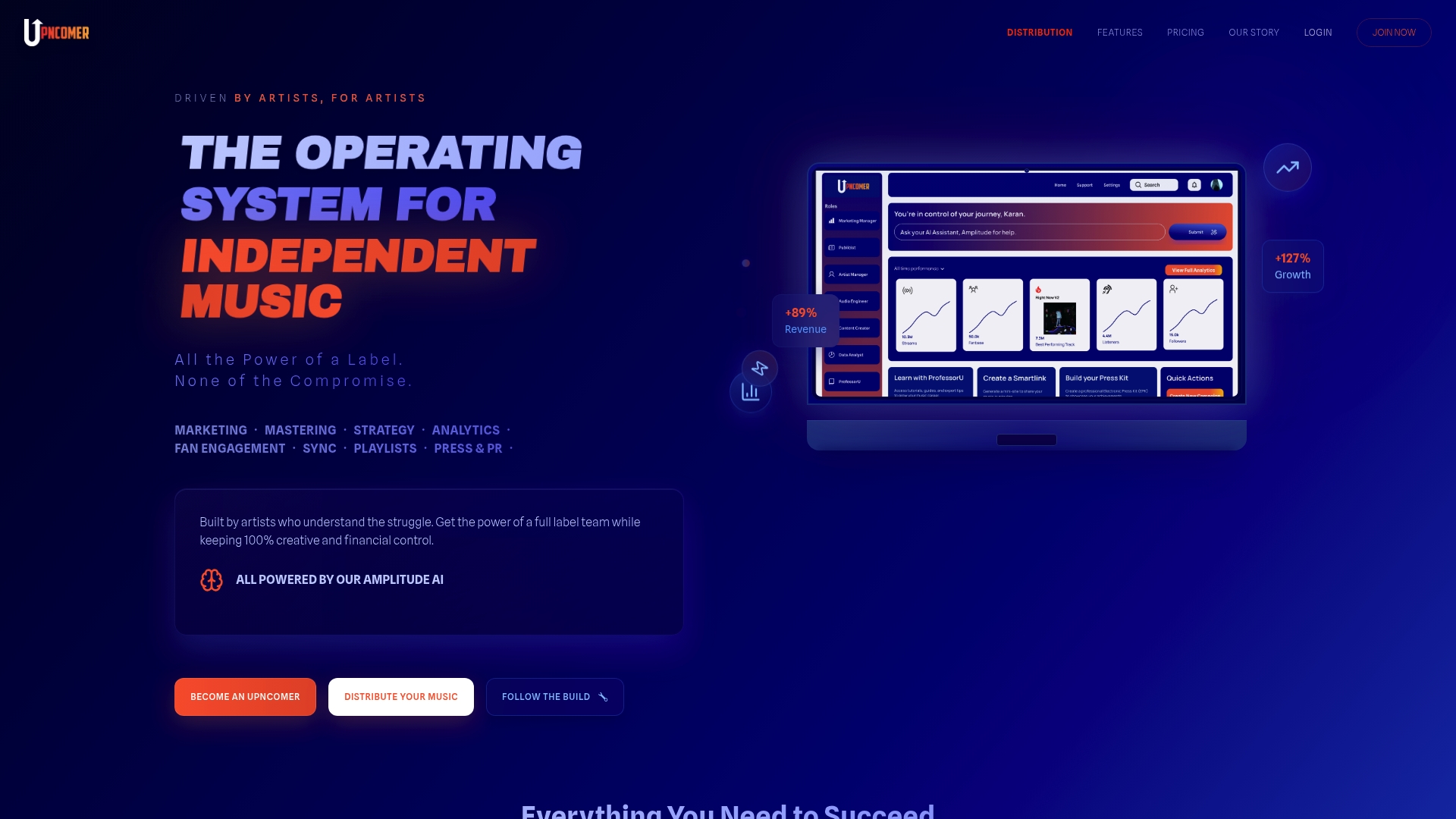
Amplitude AI can help you model what different split structures mean for your projected income, so you’re negotiating from data rather than guesswork. And because UpNComer connects distribution, analytics, and artist management in one place, you’re not manually reconciling three separate dashboards every time a payment comes in. For independent artists who want to stay in control of their catalog without hiring a full business team, that’s a real operational advantage.
Check out UpNComer’s community updates to see the latest platform features and how other independent artists are using it to manage their releases and royalty workflows.
Sources
- How to Split Music Royalties: The Complete Guide for Collaborators | Tools 4 Music
- What Co-Writers Need to Know About Songwriting Splits - ASCAP
- The Complete Guide to Song Split Sheets | Songkeeper
FAQ
How should royalties be split between co-writers?
Co-writers should agree on percentages before release and document them on a signed split sheet. Equal splits (50/50 or divided evenly among all writers) are the most common default; proportional splits based on contribution are also valid but require clear agreement in writing.
What percentage of royalties does a producer typically get?
Producers generally earn 2–5 master points early in their careers, scaling to 5–8 points for established producers and 10 or more for top-tier names. These are percentages of master royalty income, separate from any publishing royalties.
What bands or artists split royalties equally?
Equal splits are common in collaborative pop, hip-hop, and EDM sessions where multiple contributors create material together quickly. Many writing rooms default to equal shares to avoid disputes, regardless of who contributed which specific element.
How are royalties shared between publishing and master?
What happens if you don’t register splits before releasing a song?
Unregistered or mismatched splits cause PROs to place a conflict hold on payments, meaning money sits uncollected until the dispute is resolved. Mechanical royalties from The MLC may go into an unmatched pool. Registering before release is the only reliable way to collect from day one.