Artist Rollout Plan Explained: Your 12-Week Guide

An artist rollout plan is a coordinated campaign that maps your timeline, assets, promotion channels, and measurement goals around a single release. For independent artists, the standard window is several weeks for an EP or album, or a shorter window for a standalone single. Rollouts require both a phase timeline and an asset plan; missing one stalls the other every time.
Here is what a complete rollout plan covers:
- Timeline phases: tease, announcement, pre-save push, release week, and two-week sustainment
- Asset kit: final master, artwork, Canvas, press photos, EPK, lyric video, and short-form clips
- Promotion channels: playlisting, PR/press, social content calendar, and paid ads
- Measurement: KPIs beyond raw streams (saves, email signups, playlist adds, follower growth)
Think of the rollout as the difference between dropping a song and running a campaign. One is a moment; the other builds something.
Table of Contents
- What does an artist rollout timeline actually look like?
- Pre-release essentials: what you must lock before going public
- How do you pick singles and pitch playlists effectively?
- How to build your PR and press outreach list
- What should your social content calendar look like?
- How should independent artists approach paid ads?
- Release-day checklist: the first 72 hours
- How do you sustain momentum after release week?
- What should you actually measure beyond streams?
- Copyable 12-week rollout template and one-page checklist
- Key Takeaways
- What most rollout guides get wrong
- Helpful sources and further reading
- FAQ
What does an artist rollout timeline actually look like?
A phased timeline keeps your team on the same page and prevents the classic indie-artist scramble where everything lands in the same week. The grid below maps a standard 8–12 week rollout. You can steal this release plan and scale it up or compress it to a shorter window for a single.
| Phase | Weeks Out | Key Deliverables | Owner |
|---|---|---|---|
| Foundation | Weeks 12–9 | Lock master, ISRCs, metadata, distributor setup, artwork final | Artist / Manager |
| Tease | Weeks 8–6 | Behind-the-scenes content, profile updates, pre-save page live | Artist / Content Creator |
| Announcement | Weeks 5–4 | Cover art reveal, PR pitches sent, playlist curator outreach begins | Manager / Publicist |
| Pre-Save Push | Weeks 3–2 | Pre-save campaign active, social ads running, email list activated | Manager / Ads |
| Release Week | Week 0 | Song live, hero video, coordinated fan mobilization, Artist Pick set | All |
| Sustainment | Weeks +1–+2 | Repurposed clips, follow-up pitches, ad budget extended on signals | Artist / Manager |
A few things worth noting about this grid:
- Weeks 12–9 are non-negotiable — Distributors like DistroKid and TuneCore recommend submitting at least two weeks before release, but editorial pitching on Spotify for Artists closes seven days before the release date. Build in buffer.
Pre-release essentials: what you must lock before going public
The foundation phase is where campaigns either hold together or fall apart. Starting 4–6 weeks out is the minimum for independent artists, but 10–12 weeks gives you real breathing room for the tasks below.
Rights and registration
- SoundExchange: Register with SoundExchange to claim digital performance royalties from internet radio, satellite radio (SiriusXM), and streaming services that pay under the statutory license. This is separate from your PRO and covers a revenue stream many independent artists miss entirely.
Distributor setup and metadata
Lock your metadata before submission. Errors in artist name, featuring credits, or release date are harder to fix once a release is live across platforms. Confirm:
- Correct spelling of all artist and contributor names
- Genre tags that match where you want to be discovered
- Release date set with enough lead time for editorial pitching
- Explicit/clean labeling
For a deeper look at distribution setup and timelines, Upncomer’s distribution guide covers the common metadata mistakes that cost artists playlist placements.
Core asset kit checklist
- Final master (streaming-ready WAV or FLAC)
- Stems (for remixes and sync licensing)
- Cover artwork (3000×3000 px minimum, RGB)
- Spotify Canvas (3–8 second looping video, 9:16)
- Press photos (high-res, at least three angles)
- EPK / one-sheet (bio, streaming links, press angle, contact)
- Lyric video
- 5–10 short-form clips (vertical, 15–60 seconds)
Pro Tip: Assign a named owner and a hard deadline to every asset in the list above. “Deadline decay” — the pattern where teams treat the release date as the start of work rather than the finish line — is the single most common reason independent campaigns stall. Lock the cover art first; it gates everything else.
How do you pick singles and pitch playlists effectively?
Singles sequencing is strategy, not preference. Your lead single should prioritize reach: pick the track most likely to convert a first-time listener into a follower. Follow-up singles can go deeper, targeting listeners who already know you and rewarding them with something more personal or sonically adventurous.
Spotify for Artists: your primary pitching tool
Spotify for Artists is where editorial pitching happens, and the window is strict: submit at least seven days before your release date. You get one pitch per unreleased track, so choose carefully. Fill out every field — mood, style, instrumentation, and the story behind the song. Editors read these.
Beyond pitching, optimizing your Spotify profile before release matters more than most artists realize. Updated photos, linked social accounts, and a current bio all improve conversion when new listeners land on your page.
Independent curator outreach
Editorial playlists are a lottery for most independent artists. Independent curators are where you can actually move the needle. Build a tiered outreach list:
- Tier 1 (editorial): — Submit via Spotify for Artists. One shot, no follow-up.
- Tier 3 (community playlists): — Genre-specific Reddit communities, Discord servers, and blog playlists. Lower reach, but high-intent listeners.
For a practical guide on emerging artist playlists and how to get on them, Upncomer’s curator outreach guide breaks down the pitch format that actually gets responses.
Pro Tip: Save rate is the metric that tells Spotify’s algorithm a track is worth surfacing. In the first 48 hours, mobilize your inner circle — not to stream on repeat, but to save the track and follow your profile. Those two actions carry more algorithmic weight than passive plays.
How to build your PR and press outreach list
PR for an independent artist does not require a publicist on retainer. It requires a short, well-qualified list and a pitch that respects the journalist’s time. A well-structured press kit and targeted outreach can get independent artists real coverage without a big budget.
Building your media list
Qualify every contact before adding them. Ask: have they covered artists at my level in my genre in the last six months? If not, skip them. A list of 20 relevant contacts beats a spray of 200 cold emails.
Timing and embargoes
Send pitches to blogs and playlist curators three to four weeks before release. For premiere requests, reach out four to six weeks out and offer an exclusive window of 24–48 hours. Journalists appreciate the heads-up; a last-minute pitch almost never lands a premiere.
Reusable press checklist for every single:
- [ ] Media list updated and qualified
- [ ] One-sheet finalized with current streaming stats
- [ ] Private streaming link active
- [ ] Pitch email drafted and personalized per contact
- [ ] Embargo date confirmed with any premiere outlet
- [ ] Follow-up scheduled for one week after initial send
What should your social content calendar look like?
A social content calendar is not a posting schedule. It is a conversion plan. Every post should move someone from passive awareness to a specific action: a pre-save, a follow, a playlist add, or a share.
The 14-day post-release cadence
The minimum effective campaign includes a 14-day active promo window after release, not just release day. Plan for:
- Days 1–3: Hero video, first short-form clip, email newsletter send
- Days 4–7: Fan reaction content, lyric video drop, playlist add ask
- Days 8–14: Behind-the-scenes follow-up, second short-form cut, curator thank-you posts
Pro Tip: Shoot your hero video and five to ten short-form clips in the same session. Edit them to different lengths and aspect ratios before release week. That way you are publishing fresh content every few days without a new shoot, and you can split-test captions and hooks across platforms to see what drives the most saves.
How should independent artists approach paid ads?
Paid promotion does not require a big budget to move real signals. The goal for most independent artists is not mass reach; it is building a warm audience you can retarget around release.
Campaign objectives by goal
| Goal | Objective | Platform |
|---|---|---|
| Build awareness | Video views | Meta (Instagram/Facebook), TikTok |
| Drive pre-saves | Traffic / Link clicks | Meta, TikTok |
| Grow followers | Engagement | Meta, Instagram |
| Retarget warm audience | Conversions | Meta |
Release-day checklist: the first 72 hours
Release day is not the time to figure things out. Run through this checklist before you press publish and again within the first hour of going live.
Before the release goes live
- [ ] Confirm metadata displays correctly on Spotify, Apple Music, and Amazon Music
- [ ] Canvas uploaded and active on Spotify for Artists
- [ ] Artist Pick set to the new release on your Spotify profile
- [ ] Smartlink live and tested on mobile
- [ ] Pre-save conversions tallied and noted as baseline
- [ ] Email newsletter drafted and scheduled for release morning
- [ ] Social posts scheduled or queued
Hours 0–6: fan mobilization
- Send the email newsletter
- Post the hero video across YouTube, Instagram, and TikTok
- DM your core fan group (Discord, close friends list, or text) with a direct link and a specific ask: save it, follow the profile
- Activate any coordinated posting from collaborators or supporters
Hours 6–48: monitor and respond
- Track saves, completion rate, and playlist adds in Spotify for Artists
- Respond to every comment and share in the first 24 hours — this signals engagement to algorithms
- Check ad performance and pause any ad set with a cost-per-result above your target
- Note which platform is driving the most traffic via your smartlink dashboard
Hours 48–72: follow-up actions
- Send a second short-form clip to platforms where the first performed best
- Follow up with any curator or press contact who opened your pitch but did not respond
- Pull your first-48-hour save rate and compare it to your pre-save target
How do you sustain momentum after release week?
Front-loading all your energy into release day and going quiet the next week is one of the most common mistakes in independent releases. Algorithms reward sustained engagement, not a single spike.
The 14-day repurposing plan
You already shot the content. Now cut it differently. From one hero video session, you can generate:
- A full-length YouTube video
- A 60-second Instagram Reel
- A 15-second TikTok hook cut
- A lyric video (static or animated)
- A behind-the-scenes “making of” clip
- A reaction or commentary video
For a practical breakdown of turning one song into multiple content pieces, the repurposing framework at InDepthJayBeats shows how far a single session can stretch.
When to extend ad budget
Keep spending if your cost-per-save is trending down or your streaming numbers are growing day-over-day. Pause if engagement drops below your baseline and no new playlist adds are coming in. Budget extension should follow signals, not a fixed schedule.
Pro Tip: Build your full asset kit before release week, including multiple edits at different lengths. When you need fresh content on Day 9, you should be publishing, not editing. Produce everything in advance and schedule it. That discipline is what separates a two-week campaign from a one-day spike.
For more on extending a song’s life with creative repurposing, Upncomer’s guide to online music promotion covers the tactics that keep a release relevant past the first week.
What should you actually measure beyond streams?
Raw stream counts tell you almost nothing about whether a release is building your career. Set specific, testable goals for each release before it goes live.
KPI categories by goal type
Discovery goals (new audience):
- Spotify follower growth during the campaign window
- Playlist adds (editorial and independent)
- Social follower growth across platforms
Conversion goals (turning listeners into fans):
- Email list signups from the pre-save or smartlink page
- Pre-save conversion rate
- Save-to-stream ratio (saves divided by total streams)
Credibility goals (press and industry):
- Press placements secured
- Curator responses and playlist adds
- Sync or licensing inquiries
Revenue goals:
- Streaming revenue (tracked via your distributor dashboard)
- Merch sales correlated with release week
- Ticket sales for any shows tied to the release
Setting target ranges
Use a start target and a stretch target for each KPI. For example: start target of 50 new email signups, stretch target of 150. This gives you a real-time signal during the campaign. If you hit the start target in week one, you know the campaign is working and you can justify extending ad spend.
Pro Tip: Set micro-goals per phase: a pre-save target before release, a first-48-hour save rate target, and a playlist add target for week two. These phase-level checkpoints let you make real decisions mid-campaign instead of waiting until it is over to assess what happened.
Set up UTM parameters, a Meta Pixel, and conversion events before any traffic starts moving. Without these, your analytics dashboard will show you traffic but not where it came from or what it did.
Copyable 12-week rollout template and one-page checklist
This template works for a single or a small EP. Scale it up by adding a second single cycle in weeks 5–3, or compress it to 4–6 weeks by collapsing the foundation and tease phases.
12-week week-by-week table
| Week | Milestone | Owner |
|---|---|---|
| Week 12 | Lock final master, confirm ISRCs, register with PRO and SoundExchange | Artist |
| Week 11 | Submit to distributor, finalize metadata, confirm release date | Manager |
| Week 10 | Deliver cover art, Canvas, and press photos to team | Artist |
| Week 9 | Build EPK/one-sheet, set up smartlink and pre-save page | Manager |
| Week 8 | Begin tease content (BTS clips, lyric fragments), update Spotify profile | Artist |
| Week 7 | Send editorial pitch via Spotify for Artists, begin curator outreach | Manager / Publicist |
| Week 6 | Send press pitches (blogs, podcasts, premiere requests) | Publicist |
| Week 5 | Cover art reveal post, announce release date publicly | Artist |
| Week 4 | Pre-save campaign live, social ads running (video view objective) | Manager / Ads |
| Week 3 | Escalate pre-save push, follow up with press and curators | Manager |
| Week 2 | Finalize release-day schedule, brief core fan group, prep all social posts | All |
| Week 1 (Release) | Execute release-day checklist, mobilize fans, monitor KPIs | All |
| Week +1 | Repurpose content, extend ad budget on signals, follow up with curators | Manager |
| Week +2 | Final content push, pull campaign report, set goals for next release | Manager |
One-page checklist for fast implementation
Admin:
- [ ] PRO registration confirmed
- [ ] SoundExchange registration confirmed
- [ ] ISRCs assigned
- [ ] Publishing splits documented
- [ ] Distributor submission complete
Assets:
- [ ] Final master delivered
- [ ] Cover art approved (3000×3000 px)
- [ ] Canvas uploaded to Spotify for Artists
- [ ] Press photos delivered (3+ angles)
- [ ] EPK / one-sheet finalized
- [ ] Lyric video complete
- [ ] 5–10 short-form clips edited and labeled
Promotion:
- [ ] Spotify for Artists editorial pitch submitted
- [ ] Curator outreach list built and pitched
- [ ] Press list qualified and pitched
- [ ] Pre-save page live and tested
- [ ] Social content calendar scheduled
- [ ] Ad campaigns set up with tracking
Measurement:
- [ ] UTM parameters active
- [ ] Meta Pixel installed and firing
- [ ] KPI targets set (start and stretch)
- [ ] Smartlink analytics dashboard live
Scaling notes: For a larger budget or multi-single campaign, add a second single announcement in weeks 5–3 and run parallel ad sets for each track. For a 4–6 week condensed rollout, combine the foundation and tease phases and prioritize curator outreach over press.
Key Takeaways
A successful artist rollout plan coordinates timeline, assets, promotion, and measurement across 8–12 weeks, with the first 48 hours after release being the most critical window for algorithmic signals.
| Point | Details |
|---|---|
| Start 8–12 weeks out | Lock your master, metadata, and assets before any public push to prevent deadline decay. |
| Register rights early | Set up PRO, SoundExchange, and ISRCs before distribution so every royalty stream is captured from day one. |
| Pitch Spotify for Artists 7+ days before release | The editorial submission window closes one week before release; missing it means waiting for the next single. |
| Measure beyond streams | Track saves, email signups, playlist adds, and follower growth to know if the campaign is building your career. |
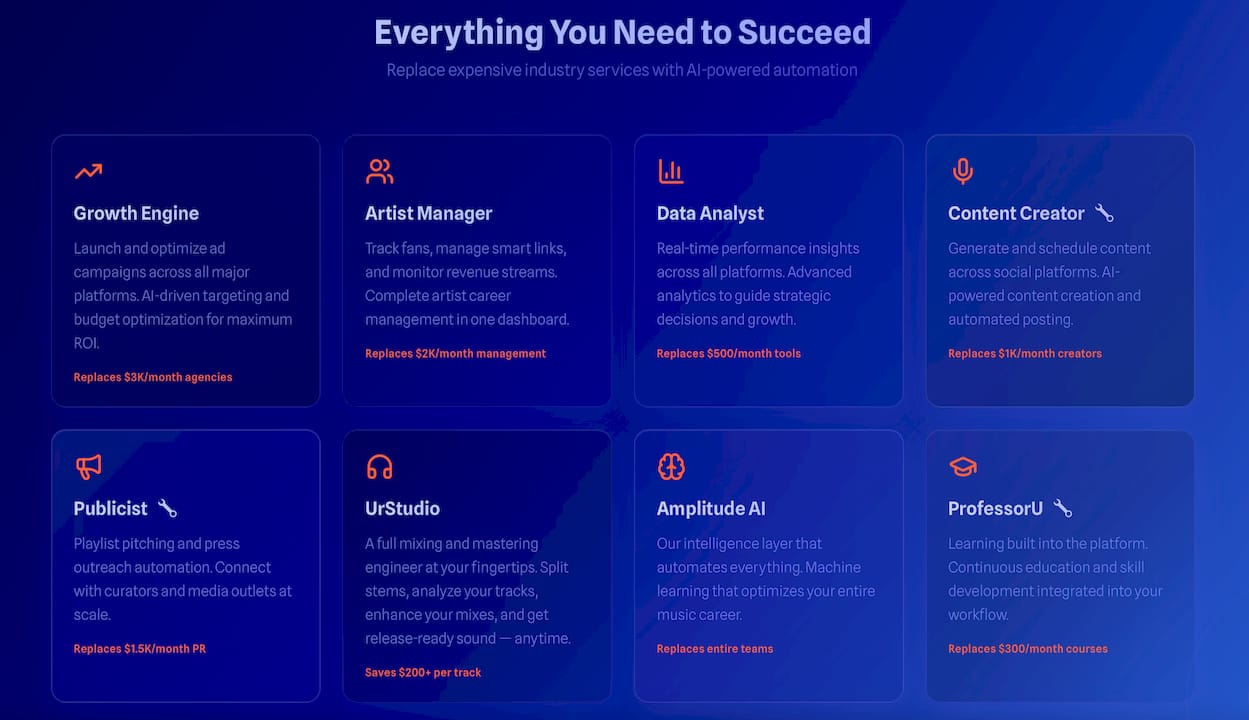
| Use Upncomer for unified execution | Upncomer’s Growth Engine, Distribution, Amplitude AI, and Content Creator modules map directly to each rollout phase, replacing fragmented tools with one system. |
What most rollout guides get wrong
Most rollout advice is written for artists with a team already in place: a manager handling pitching, a publicist on press, and a label covering ads. For independent artists running everything themselves, the real challenge is not knowing what to do. It is knowing what to do first and what to skip when time is short.
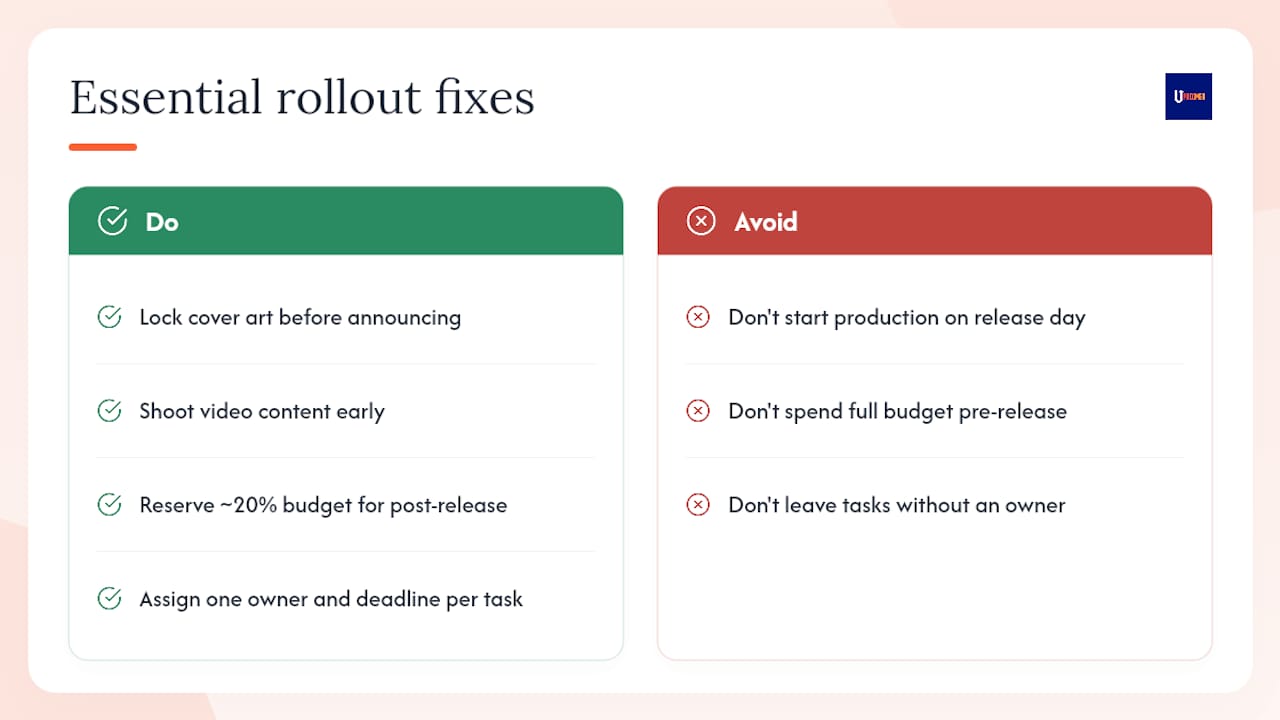
The operational rules that actually matter are smaller than most guides admit. Lock your cover art before you announce anything, because the art gates your Canvas, your pre-save graphic, and your press kit. Shoot your video content earlier than feels necessary, because editing always takes longer than planned. Allocate roughly 20% of your total campaign budget for the post-release window rather than spending everything before the song is live.
Responsibility assignment is where most solo artists lose time. Every task needs one owner, one deadline, and one approval step. When the artist is also the manager and the content creator, the approval loop collapses into a single person, which sounds efficient until a missed deadline cascades into a delayed pitch or a missing Canvas on release day. The fix is a simple shared doc: task, owner, deadline, status. That document is the rollout plan in practice.
The artists who run the cleanest campaigns are not the ones with the biggest budgets. They are the ones who treat the release date as the finish line of a production process, not the starting gun.
Helpful sources and further reading
These are the primary references used throughout this guide. Each one is worth bookmarking.
- How to Plan an Album Rollout (2026 Step-by-Step Guide) | Storyflow
- Best Release Rollout Checklist for Artists – De Novo Agency
- Post and Pray Problem: Plan a Real Release in 2026 | Echonos
- Steal this release plan (2026 edition): a practical roll-out strategy for independent artists
- How to Plan a 30-Day Music Release Rollout That Actually Works — ArtistPulse Blog
- soundexchange.com
- artists.spotify.com
- artists.spotify.com
- artists.spotify.com
FAQ
What is an artist rollout plan?
An artist rollout plan is a coordinated campaign that sequences your timeline, assets, promotion, and measurement around a music release. For independent artists, the standard window is 8–12 weeks for an EP or album, or 4–6 weeks for a single.
What makes a good album rollout?
A good rollout combines a locked asset kit (master, artwork, Canvas, short-form clips, EPK) with a phased timeline that includes a tease period, a pre-save push, a coordinated release day, and at least two weeks of post-release sustainment. Missing either the asset plan or the timeline is the most common reason campaigns stall.
How do you pitch to Spotify editorial playlists?
Submit your track through Spotify for Artists at least seven days before your release date. You get one pitch per unreleased track, so fill out every field including mood, style, and the story behind the song.
What KPIs should independent artists track beyond streams?
Track saves, playlist adds, email signups, follower growth, and your save-to-stream ratio. These metrics tell you whether a release is building a real audience, not just accumulating passive plays.
How does Upncomer help with a music rollout?
Upncomer’s platform covers the full rollout stack: Distribution for metadata and delivery, Growth Engine for ad campaigns and audience building, Amplitude AI for streaming analytics, Content Creator for asset generation, and Publicist for pitch automation. It replaces the fragmented tool stack most independent artists use with one unified system.